[Report 1964] / Medical Officer of Health, Eccles Borough.
- Eccles (Greater Manchester, England). Borough Council.
- Date:
- 1964
Licence: Attribution 4.0 International (CC BY 4.0)
Credit: [Report 1964] / Medical Officer of Health, Eccles Borough. Source: Wellcome Collection.
38/88 (page 36)
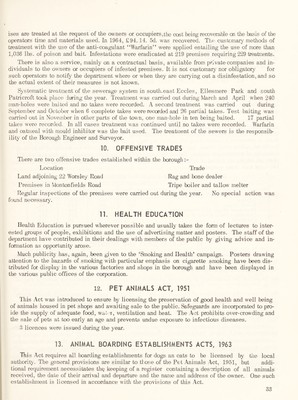
![- The Municipal Ashbin Scheme commenced in 1949. The renewal and repair of aslibins used for domestic refuse is a service provided by the department and since the inception of the scheme 16,361 bins have been provided. From 1959, ashbins which are superior to the B.S.S. bins ha/e lieen pro’dded. These bins have been proved a better proposition and have given longer service than the B.S.S. bins purchased previously. Ru' tber covers are now provided with all replacement bins and these will be a contribution to noise abatement. Bulk containers ol 1]^ cubic yard capacity are in use at several trading establishments, all multi- storey flats and the Eccles and Patricroft Hospital. A second vehicle adapted for mechanical loading of these containers has been purchased and it is hoped to extend the service toother prem- ises during the forthcoming year. A pilot scheme for the removal of refuse by the non-returnable paper sack method was intro- duced on the new Crossfield Farm Estate. Such sacks are collected weekly. With this system, eacli house uses a strong, waterproof paper sack, on a freestanding metal/concrete holder. All are fitted v/ith a quietly operating lid made of rubber. The refuse collector removes the full sack and replaces it with an empty one. With the adoption of this method, all refuse is removed, noise is reduced and the refuse collector has a cleaner and lighter task. Unfortunately, the major disadvantage to this very desirable improvement is the cost. It is pos- sible that local authorities in tJie future may find difficulty in recruiting staff to empty dustbins. Should they wait for this to come, or operate a modem method of refuse collection without further delay ? It is possible that cheaper sacks made of other materials will be introduced in the near future and so reduce the operating costs. Another problem has come to the forefront recently, namely the collection and disposal of “dis- posable” articles such as soiled dressing and the products arising from home confinements. This applies especially in smoke control areas and particularly in houses in such areas where “central heating” by oil, gas or electricity is is use. This disposal is undoubtedly the job of the local authority and usually means special calls at individual houses which have beeii notified by the nursing or midwifery services (b) REFUSE DISPOSAL The bulk of the refuse collected is disposed of at the controlled tip situated in the Wors- ley urban district. There are two men employed on the tip, a tractor-loader driver (designated tip foreman) and an attendant. The tip and approach roads are founded on a deep layer of peat, and constant attention has to be given to the filling in of depressions which occur due to uneven set- tlement taking place. The approach road from Brookliouse Estate to the tip has an excellent surface, but the road through the tip requires regular attention, especially in the winter. Vandalism and pilfering from the tip causes a great deal of inconvenience. Income of £2,604 was realised from the removal and destruction of trade refuse compared with £2,341 for 1963. The salvageable materials are stored at Devonshire Road depot. Waste paper and rags are baled. An income of £3,350 was derived from the sale of these materials. Details are given in Table XXVIII. In addition to the 18,229 tons of household refuse disposed of 9,788 tons of builders refuse, soil, sand, etc., were tipped making a total of 28,017 tons during 1964.](https://iiif.wellcomecollection.org/image/b29189640_0038.jp2/full/800%2C/0/default.jpg)