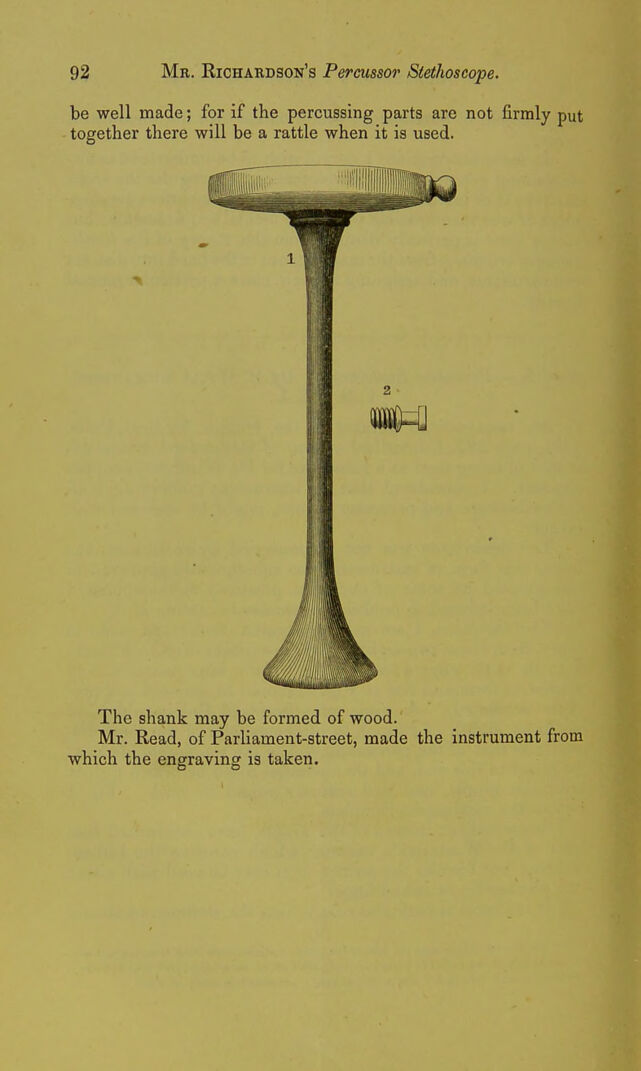
Percussor stethoscope / by B. Wills Richardson.
- Richardson, Benjamin Wills.
- Date:
- [cbetween 1800 and 1899?]
Licence: Public Domain Mark
Credit: Percussor stethoscope / by B. Wills Richardson. Source: Wellcome Collection.
Provider: This material has been provided by The University of Glasgow Library. The original may be consulted at The University of Glasgow Library.
115/126 page 21
![few in number, and Melicher^—the latest and best authority on the subject—says that lie never saw a case of truly congenital luxation occasioned by it. c. Hydrarthrosis. We have already, more than once, made reference to results stated in a paper written by M. Parise, in volume xiv. of the Archives Genh-ales de Medecine. The object of this admirable monograph was to prove that dropsical effusions into the cavity of the acetabulum were the usual and principal causes of spontaneous dislocation of the head of the femur. He found that artificial injec- tions of the hip-joint had the effect of causing this luxation; and he reasoned analogically, that a preternatm'ally great amount of syno- vial seci'etion would produce, pathologically, what he had done ex- ])erimentally. That hydrarthrosis may be an occasional cause of congenital luxation of the femur, I do not doubt, but that it is by any means a constant or miiform accompaniment of the lesion, appears to me highly improbable. Indeed the testimony of Parise himself seems to destroy the exclusiveness of his theoiy; for, out of 332 cases, in which he examined the joints of new-boi*n infants, dm'ing the time he was house-surgeon to the Hopital des Enfans Trouvh, at Paris, he only found three in wdiich he could distinctly trace congenital dislocation to this cause.^ d. Hypertrophy of the Haversian Gland. Pai'ise and others believe that the displacement may also result from an increased growth of those adipose folds, generally found within the synovial membrane of the hip-joint, which have been somewhat erroneously denominated Haversian Glands but which are, in reality, merely vascular accumulations of fat-cells. In sup- port of this theory, these authors have related cases of congenital luxation, in which there existed visible hypertrophy of these masses; but the assertion that, in these cases, tlie displacement was caused by the enlargement of the Haversian glands appears to me a most unwarrantable application of the post hoc ergo projjter hoc line of argument. The increased growth of the adipose substance in these instances seems to be rather the result than the cause of the luxa- tion; for, had the head of the femur remained in situ, i\\cve is every likelihood that its presence and pressure would have restrained that hypertrophy, which occurred exuberantly as the sequence of its dis- placement. e. Muscidar Retraction. In the great majority of cases I believe congenital luxations to be occasioned by the influence of jBuscular retraction. Guerin was * Op. cit. ' It was in the dissection of one of these cases that he observed the elonga- tion of the round ligament to wiiich I liave already alluded.](https://iiif.wellcomecollection.org/image/b21477784_0115.jp2/full/800%2C/0/default.jpg)