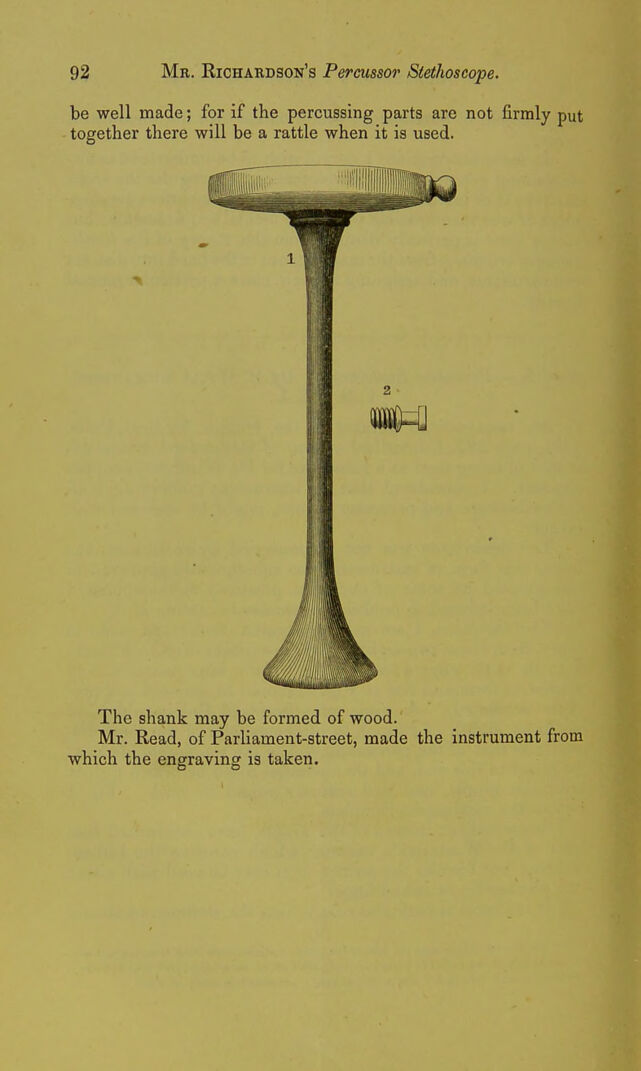
Percussor stethoscope / by B. Wills Richardson.
- Richardson, Benjamin Wills.
- Date:
- [cbetween 1800 and 1899?]
Licence: Public Domain Mark
Credit: Percussor stethoscope / by B. Wills Richardson. Source: Wellcome Collection.
Provider: This material has been provided by The University of Glasgow Library. The original may be consulted at The University of Glasgow Library.
87/126 page 53
![mens, when first removed from the body, and preparations preserved in museums, not unfrequently present the appearance of increased thickening of the walls of the right ventricle, with diminution of its cavity. These appearances are, however, I believe, deceptive, and depend upon specimens being examined, or the preparations having been immersed in spirit, before the tonic contraction of the muscular fibres had subsided. I have seen cases of malformation in which, when the right ventricle was first laid open, there seemed to be ab- solutely no cavity, but in which, after maceration, the ventricle proved to be unusually large. In cases in which the maintainence of the circulation is thrown upon the left ventricle, as when the right auriculo-ventricular aper- ture is obliterated, or when that opening or the pulmonary orifice is greatly contracted after the complete development of the septum of the ventricles, the left, ventricle becomes much hypertrophied and dilated, while the right ventricle undergoes a proportionate decrease in size. In some of these cases, indeed, the right ventricle becomes reduced to a small hollow, about the size of a pea, which is sur- rounded by thick ventricular walls; but this condition is clearly one of atrophy, not of hypertrophy, and the defective nutrition of the muscular substance of the right ventricle from disuse, is shown by its unusual paleness and flaccidity, and by the looseness of its texture. General Remarks on the Dimensions of the Diseased Heart.—The changes which the heart undergoes in disease have attracted the atten- tion of most systematic writers, and especially of Laennec, Bertin, Lobstein, Cruveilhier, and Hope; and I may particularly refer to the series of observations published by Bouillaud, and to the inci- dental allusions to the measurements of the organ in cases of dis- ease, contained in Dr Banking's valuable paper. It may not be without interest to compare the observations of these writers with the results obtained from the analysis of the cases now published. The circumference of the largest heart measured byM. Bouillaud was 12 French inches, and of that mentioned by Dr Eanking 12| English inches—(limensions which very nearly correspond. In my own tables the dimensions are given of the heart of a male in a case of hy])ertrophy without valvular disease, which measured 15 inches and 2 lines French, or somewhat above 16 English inches in circumference, and one of incompetency of the aortic valves, in which the circumference of the heart was 14 inches and 3 lines, or about 15 English inches. In females the extreme circumference of the heart was 10 inches and 7 lines, or about 11 English inches, in a case of mitral valvular disease, and 10 inches and G lines in one of combined aortic and mitral disease, and 10 inches in one of ob- structive disease at the aortic orifice.^ ' M. Bouillaud, for purposes of comparison, gives the weight and dimensions](https://iiif.wellcomecollection.org/image/b21477784_0087.jp2/full/800%2C/0/default.jpg)