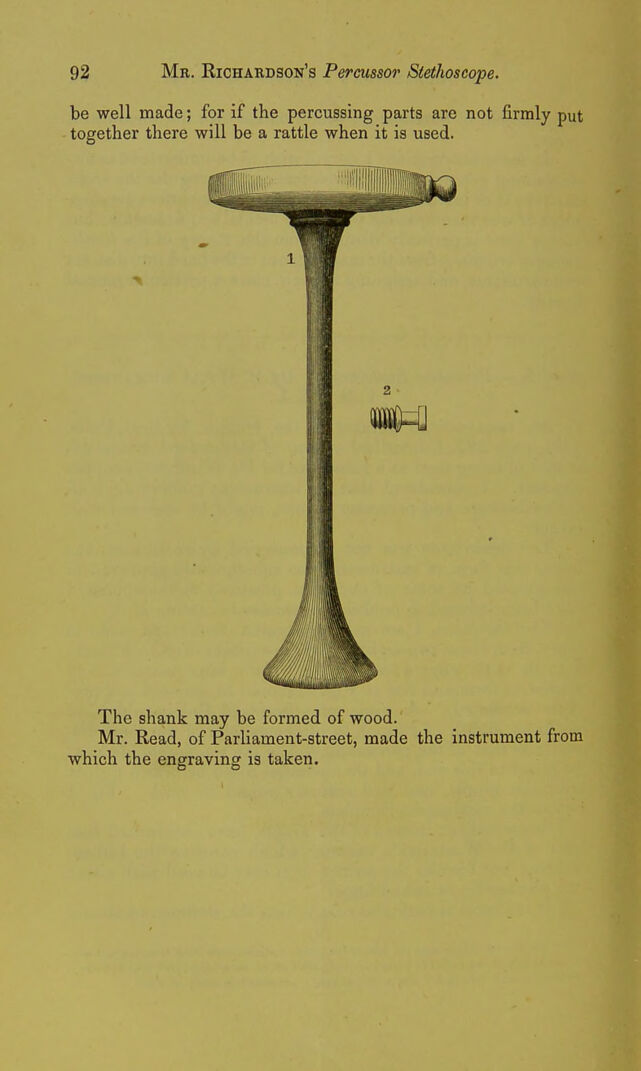
Percussor stethoscope / by B. Wills Richardson.
- Richardson, Benjamin Wills.
- Date:
- [cbetween 1800 and 1899?]
Licence: Public Domain Mark
Credit: Percussor stethoscope / by B. Wills Richardson. Source: Wellcome Collection.
Provider: This material has been provided by The University of Glasgow Library. The original may be consulted at The University of Glasgow Library.
89/126 page 55
![and Hope mentions, that tlie walls of the left ventricle may attain a tliickness of one, one and a half, or, according to some, of two inches ; and he mentions a case in which they were 1^ inch thick in a case of regm'gitation through the aortic orifice. The extreme thickness of tlie parieties of the left ventricle in the cases mentioned by Bonillaud, is 13 lines. Of the hearts examined by Ranking, in one the walls of the left ventricle attained a width of one inch, or about 11^ lines, and Bertin mentions a case in which they were upwards of one inch in thickness. The greatest width of the parieties of the left ventricle in the cases given in the present memou, was in males 11 lines, in cases of hypertrophy without valvular disease, and of aortic cUsease, and of dilatation of the aorta with chronic bronchitis ; but another case is referred to, in which there was slight valvular disease with dilata- tion of the aorta, and the parieties of the left ventricle measured 14 lines in width. In females the greatest thickness of the walls of the left ventricle was 10 and 11 lines, in cases of conabined aortic and mitral valvular disease. The septum of the ventricles is mentioned by M. Bertin to have been found by him one inch in thickness; the greatest width in M. Bouillaud's observations is 10 lines, and Dr Eankins found it 38-48ths of an English inch (8*75 lines) in one case. In the pre- sent observations the greatest width in males is 10 and 11 lines in cases of hypertrophy without valvular disease, and 9 lines in cases of incompetency. In females the greatest width is 6 lines in a case of mitral valvular disease. I regret, that in the observations, the dimensions of the septum were less frequently obtained than would have been desirable. The parieties of the right auricle were found by M. Bouillaud, in two cases, to measure 3 and 3^ lines in width, but his measurements are taken near the appendix, where oi'dinarily the walls are thicker than across the middle of the sinus. Bertin also examined a heart in which the walls of the right ventricle had a width of 3 lines ; and Dr Ho])e speaks of a thickness of a quarter of an inch as occasionally seen. In my own observations, the Avails of the right auricle attained a width of 3 lines in only one case, that of the female, 19 years of age, in whom congenital contraction of the pulmonary aperture and deficiency of the septum of the ventricles, was combined with some disease of the tricuspid valves. The parieties of the right auricle measured 2^ lines in a case of combined mitral and aortic disease, in a boy of 18 years of age, and attained the same thickness in a case of aneurism of the apex of the left ventricle, with open fora- men ovale. They were also 2 lines thick in the case of great con- traction of the mitral and tricuspid valves, and in one of combined aortic and mitral valvular disease. The maximum thickness of the parieties of the left auricle, men- tioned by M. Bouillaud, is 2i lines. In my own observations its greatest width was two lines in cases of regurgitation through the](https://iiif.wellcomecollection.org/image/b21477784_0089.jp2/full/800%2C/0/default.jpg)