Diabetes mellitus and its treatment / by R. T. Williamson.
- Williamson, Richard Thomas.
- Date:
- 1898
Licence: Public Domain Mark
Credit: Diabetes mellitus and its treatment / by R. T. Williamson. Source: Wellcome Collection.
Provider: This material has been provided by the Augustus C. Long Health Sciences Library at Columbia University and Columbia University Libraries/Information Services, through the Medical Heritage Library. The original may be consulted at the the Augustus C. Long Health Sciences Library at Columbia University and Columbia University.
45/476 (page 25)
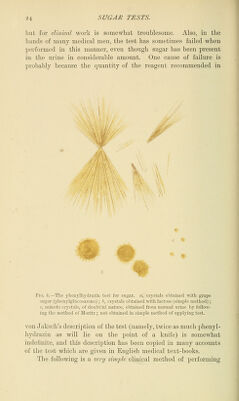
![the phenylhydrazm test, which I have employed for seven years with the best results — a method described in foreign medical literature some years ago, but not generally referred to in English medical books. The simple method to which I refer has been described in the work on urine analysis by Hoffmann and Ultzmann, and the following, which I have found so useful, is a very slight modifi- cation thereof. A test tube of ordinary size is filled for about half an inch with hydrochlorate of phenylhydrazin 1 (in powder); then acetate of soda in powder (or small crystals) is added for another half inch. The test tube is then half-filled with urine and boiled over a spirit-lamp. In performing the test I have not attempted to dissolve the salts by shaking the tube, but have simply applied the flame of the lamp to the bottom of the tube, and the powders have soon passed into solution. After the urine has reached the boiling point, I have always continued to boil for about two minutes. The tube is then left in the test stand and examined again some time afterwards. If sugar be present, a yellowish deposit forms at the bottom of the tube, and on microscopical examination this deposit is seen to consist chiefly of beautiful needle-shaped crystals of a bright sulphur-yellow colour. Generally the needles are arranged in tufts, sheaves, or rosettes. The crystals are found after the tube has been standing for half an hour, frequently at the end of fifteen or twenty minutes; but after boiling the tube I have generally placed it in a test stand and not examined the deposit for a few hours. If no sugar is present, only brownish amorphous globules or yellowish scales are found in the deposit. This method is exceedingly simple, and very little time and attention are required. In four minutes the first part of the test can be easily completed; the tube is then left in the test stand and examined at a convenient time some hours later. Permanent specimens of the crystals can be prepared by drying a little of the deposit on a slide and mounting it in Canada balsam. The value of the test.—I have used this simplified method for seven years in a very large number of urine examinations, 1 Hydrochlorate of phenylhydrazin is a brownish powder having a peculiar sine]]. It is simply kept in tin; powdered form in a dry liottle. The acetate of soda is also kept in a dry powder in another bottle.](https://iiif.wellcomecollection.org/image/b21203970_0045.jp2/full/800%2C/0/default.jpg)