The principles and practice of surgery : founded on the most extensive hospital and private practice, during a period of nearly fifty years; with numerous plates, illustrative both of healthy and diseased structure / by Astley Cooper ; edited by Alexander Lee.
- Cooper, Astley, Sir, 1768-1841.
- Date:
- 1836-1837
Licence: Public Domain Mark
Credit: The principles and practice of surgery : founded on the most extensive hospital and private practice, during a period of nearly fifty years; with numerous plates, illustrative both of healthy and diseased structure / by Astley Cooper ; edited by Alexander Lee. Source: Wellcome Collection.
Provider: This material has been provided by Royal College of Physicians, London. The original may be consulted at Royal College of Physicians, London.
653/1190
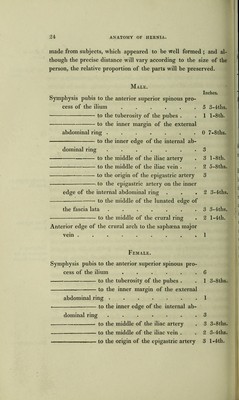
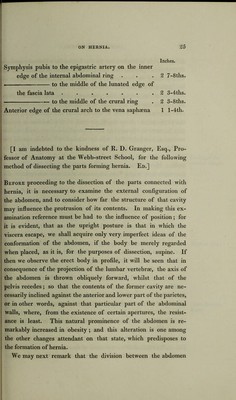
![i Inches. ; Symphysis pubis to the epigastric artery on the inner edge of the internal abdominal ring . . .2 7-8ths. . to the middle of the lunated edge of the fascia lata ...... .2 3-4ths. to the middle of the crural ring . 2 3-8ths. Anterior edge of the crural arch to the vena saphaena 1 l-4th. [I am indebted to the kindness of R. D. Granger, Esq., Pro- fessor of Anatomy at the Webb-street School, for the following method of dissecting the parts forming hernia. Ed.] Before proceeding to the dissection of the parts connected with hernia, it is necessary to examine the external configuration of the abdomen, and to consider how far the structure of that cavity may influence the protrusion of its contents. In making this ex- amination reference must be had to the influence of position; for it is evident, that as the upright posture is that in which the viscera escape, we shall acquire only very imperfect ideas of the conformation of the abdomen, if the body be merely regarded when placed, as it is, for the purposes of dissection, supine. If then we observe the erect body in profile, it will be seen that in consequence of the projection of the lumbar vertebrae, the axis of the abdomen is thrown obliquely forward, whilst that of the pelvis recedes ; so that the contents of the former cavity are ne- cessarily inclined against the anterior and lower part of the parietes, or in other words, against that particular part of the abdominal walls, where, from the existence of certain apertures, the resist- ance is least. This natural prominence of the abdomen is re- markably increased in obesity ; and this alteration is one among the other changes attendant on that state, which predisposes to the formation of hernia. We may next remark that the division between the abdomen](https://iiif.wellcomecollection.org/image/b28525474_0665.jp2/full/800%2C/0/default.jpg)