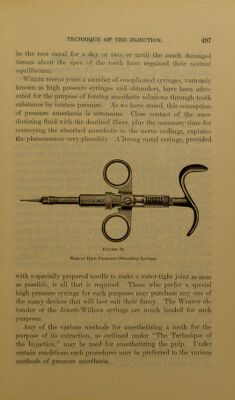
Dental materia medica and therapeutics : with special reference to the rational application of remedial measures to dental diseases a textbook for students and practitioners / by Hermann Prinz.
- Prinz, Hermann, 1868-1957
- Date:
- 1913
Licence: In copyright
Credit: Dental materia medica and therapeutics : with special reference to the rational application of remedial measures to dental diseases a textbook for students and practitioners / by Hermann Prinz. Source: Wellcome Collection.
501/600
![concretions of various shapes. It should be kept in mind that only a few drops of a 2-percent novocain-adrenalin solution are required to completely anesthetize the pulp, provided sufficient time be allowed for the action of the anesthetic, and the anesthesia lasts from forty to sixty minutes. For anatomic reasons the best results are obtained in the anterior teeth. The objections made to this method that the pulp may die, or otherwise become injured by the anesthetic, are unfounded, provided the minimum quantity of the anesthetic solution is used. We have been able to satisfac- torily demonstrate by tests made with the electric current, accord- ing to Schroder’s suggestion, that the pulp always regained its normal activity after it had been anesthetized for the above pur- pose. Recently exhaustive tests have been made on animals by Euler, of the Dental School of the University of Heidelberg, with a view to establishing the possibility of producing death of the tooth pulp by injecting novocain-adrenalin according to the above method. In no case did he succeed in permanently injuring the pulp even by employing relatively large quantities of the above solution. Accidentally cutting into the pulp in preparing the cavity may be considered a source of danger, as the normal sensa- tion of the pulp, which acts as a warning guide when too closely encroached upon, is temporarily abolished, and this fact may mis- lead the operator when excavating a cavity. Careful observation of the field of operation will cause a halt when the danger line is approached. Some years ago potassocoin, a solution, of cocain in alcohol and ether, with the addition of a small quantity of caustic potash, and vapocain, “a local obtundent containing 15 percent cocain hydro- chlorid in ethereal solution,” were freely discussed in dental litera- ture as useful remedies for the treatment of hypersensitive dentin. Both solutions are active only through their cocain component, 'riic latter is materially interfered with in its ready absor])tion by the alcohol or ether solvent. Pota.ssocoin apparently dis^ii)])eared from the market, while vapocain is seemingly still in use. When applied to dentin, the ether has to be evaporated before the cocain can act on the dentinal fibers, and has to be redissolved by the aqueous contents of the tubules in order to act. Vapocain is found](https://iiif.wellcomecollection.org/image/b28105643_0501.jp2/full/800%2C/0/default.jpg)