The action of the cinchona and certain other alkaloids in bird malaria. Pt. 2 / by G.A.H. Buttle, T.A. Henry and J.W. Trevan.
- Buttle, G. A. H. (Gladwin Albert Hurst), 1899-1983.
- Date:
- [1934]
Licence: Public Domain Mark
Credit: The action of the cinchona and certain other alkaloids in bird malaria. Pt. 2 / by G.A.H. Buttle, T.A. Henry and J.W. Trevan. Source: Wellcome Collection.
12/22 (page 436)
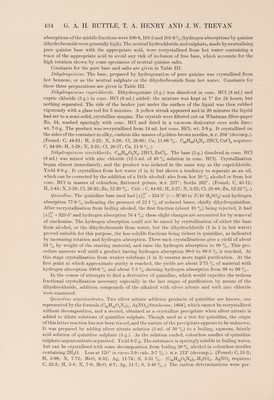
![Dihydroquinidine. This base, prepared by catalytic hydrogenation of pure quinidine was crystallised from boiling alcohol, or as the dihydrobromide from water. Dihydroquinidine cuprichloride was prepared by mixing the base (2 g.) with cupric chloride (2 g.) each having been dissolved separately in cone. HC1 (5 ml.). Nothing separated on standing for 24 hours except a few crystals of cupric chloride, but on rubbing the side of the beaker, yellow granules appeared and the whole liquid quickly became semi-solid. Wt. 1-71 g. It was re¬ crystallised from hot cone. HC1 (1 in 1*5 ml.) from which it separated in clusters of thin, dark orange, rectangular prisms, m.p. 222° (decomp.). Yield 0-9 g. (Found: C, 44-94; H, 5-37; N, 5-17; Cl, 26-55; Cu, 11-92 %. C20H26O2N2.2HC1, CuCl2 requires: C, 44-98; H, 5-28; N, 5-25; Cl, 26-57; Cu, 11-91 %.) Dihydroquinidine zincichloride was prepared by mixing the base (2 g.) in cone. HC1 (5 ml.) with zinc chloride (5 ml. of 40 % solution in cone. HC1). Nothing crystallised out until the inside of the beaker was rubbed vigorously with a glass rod. Wt. 1-7 g. It can be recrystallised from water, 50 % alcohol or hot cone. HC1 (1 g. in 2 ml.) and separates from the latter in colourless, spheroidal masses of minute silky needles, m.p. 249-252° (decomp.). (Found: C, 44-6; H, 5-31; N, 5-19; Cl, 26-45; Zn, 12-00 %. C20H26O2N2.2HC1, ZnCl2 requires: C, 44-82; H, 5-27; N, 5-23; Cl, 26-48; Zn, 12-22 %.) Constants for dihydroquinidine and its salts are given in Table III. Table III. Constants of pure cinchona alkaloids. Methoxy-bases: quinine, dihydroquinine; quinidine, dihydroquinidine. [a]^ calc, for f-AAdditional Substance an c* Solvent Salt Base constants Quinine (Q): Base, m.p. 173-5° - 4-611° M/40 ivyio h2so4 — -284-5° H.A.t =99-93 Acid sulphate, Q.H2S04, 7H20 -17-875 M/10 Water -211-7° -275-9 H.A. =100-1: pH=2-86 5? - 4-555 M/40 -216-1 -281-4 pH=3-08 5? 5? - 4-607 M/40 iV/10 h„so4 -218-3 -284-3 — Neutral sulphate, Q2.H2S04, 7H20 - 4-608 ilf/40 N/10 H2S04 -247-1 -284-4 — Dihydrobromide, Q.2HBr, 3H20 -17-890 M/10 W ater -184-1 -276-2 H.A. =100-8: pH =2-61 - 4-608 ilf/40 5 5 -189-6 -284-4 pH=2-94 Neutral hydrochloride, Q.HC1,2H20 - 4-597 ilf/40 N/10 H2S04 -255-1 -283-8 — - 4-582 ilf/40 iV/10 HC1 -254-3 -282-9 — Dihydroquinine (HQ): Base, m.p. 173-5° - 3-842 ilf/40 iV/10 h2so4 — -235-7 — Dihydrobromide, HQ.2HBr, 3H20 -14-880 M/10 W ater -152-5 -228-3 — - 3-845 ilf/40 5 * -157-5 -235-8 — Neutral sulphate, (HQ)2.H2S04, 6H20 - 3-838 M/40 N/10 H2S04 -204-6 -235-4 — Quinidine (Qd): Base, m.p. 173-5° + 5-415 ilf/40 Nj 10 H2S04 — +334-2 H.A. =99-8 % Acid sulphate, Qd. H2S04, 4H20 +20-915 M/10 W ater +247-8 +322-7 — + 5-409 ilf/40 iV/10 h2so4 +256-4 +333-9 — Dihydrobromide, Qd.2HBr, 3H20 +21-315 ilf/10 Water +219-3 +328-9 — + 5-420 M/40 1 +223-0 +334-5 — Dihydroquinidine (HQd): Base, m.p. 169-5° + 4-875 ilf/40 N/10 H2S04 — +299 — Dihydrobromide, HQd.2HBr, 3H20 + 19-178 ilf/10 Water + 196-5 +294-2 — + 4-890 ilf/40 +200-4 +300 — * c is expressed as dry substance. t H.A. =hydrogen absorption: % of calculated value (p. 432). Cinchonidine. Commercial cinchonidine is stated to contain quinine 10 % and dihydro- cinchonidine 8 % [Dawson and Garbade, 1930]. The base, used as a starting material, showed strong fluorescence on solution in dilute sulphuric acid, had [a]^ - 183-2° (c = ilf/40 in N/10 H2S04) hydrogen absorption 97-9 % and contained methoxyl 0-66 %. These results indicate the presence of quinine (about 6-9 %) and dihydrocinchonidine (about 2 %). It was found that crystallisation three times from boiling benzene (1 in 30), the first fractions only being collected, yielded about 78 % of a product, which passed the fluorescence test (p. 431) and in which no methoxyl could be detected. This, on fractional crystallisation from alcohol](https://iiif.wellcomecollection.org/image/b30629925_0012.jp2/full/800%2C/0/default.jpg)