The action of the cinchona and certain other alkaloids in bird malaria. Pt. 2 / by G.A.H. Buttle, T.A. Henry and J.W. Trevan.
- Buttle, G. A. H. (Gladwin Albert Hurst), 1899-1983.
- Date:
- [1934]
Licence: Public Domain Mark
Credit: The action of the cinchona and certain other alkaloids in bird malaria. Pt. 2 / by G.A.H. Buttle, T.A. Henry and J.W. Trevan. Source: Wellcome Collection.
13/22 (page 437)
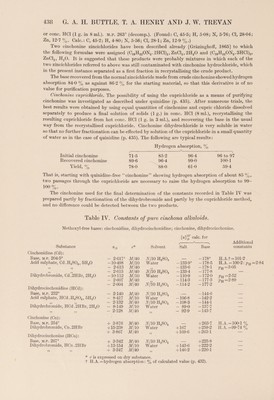
![(1 in 6), yielded first and third fractions having hydrogen absorptions of 98 to 99 % and a middle fraction with hydrogen absorption 101-2 %, the yield of the latter being about 25 % of the original material. In some cases it was necessary to crystallise the quinine-free product twice from alcohol, in order to reach this degree of purity. The constants for the base, acid sulphate and dihydrobromide are recorded in Table IV. Dihydrocinchonidine. The base prepared by hydrogenation of pure cinehonidine was re- crystallised from boiling benzene and finally from alcohol, or as the dihydrobromide from water. The constants are given in Table IV. The cuprichloride was prepared by mixing the base (3 g.) in cone. HC1 (4 ml.) with cupric chloride (3 g.) in cone. HC1 (5 ml.). Even after vigorous rubbing of the cooled liquid with a glass rod no crystals appeared, but after 24 hours at 7°, a crop of minute pale, canary-yellow needles separated, wt. 2-6 g. It was recrystallised in the same way from warm cone. HC1 (3 ml.), wt. To g., and was dried on a porous tile. It sinters at 120-140°, melts at 166° and froths at 183°. (Found on substance dried at 90° in vacuo: C, 44-52; H, 5-29; X, 5-5; Cl, 28-15; Cu, 12-83%. Cl9H24OX2.2HC1, CuCl2 requires: C, 45-27; H, 5-20; N, 5-56; Cl, 28-16; Cu, 12-62 %.) Cinchonine. The commercial cinchonine used was markedly fluorescent in dilute sulphuric acid, contained methoxyl 0-25 %, corresponding to quinidine 2-6 % and had [a]^ +264-5 (c = iH/40 in N/10 H2S04) and hydrogen absorption 86-2 % indicating the presence of 13-8 % of dihydrocinchonine. After three crystallisations from boiling alcohol (1 in 30) it passed the fluorescence test (p. 431) and the figure for hydrogen absorption fell to 84-9 owing to removal of quinidine. This partially purified base was converted into dihydrobromide and recrystallised from water (1 in 1). The first crop, which is rich in dihydrocinchonine is rejected and successive crops are obtained by slow concentration of the mother-liquor in a vacuous desiccator over sulphuric acid. When a conveniently large crop has accumulated in this way, it is scraped down into the mother-liquor, dissolved by warming and left to crystallise out again. The fourth crop so obtained had hydrogen absorption 93-94 %• When a hydrogen absorption about 95 % is reached, crystal¬ lisation is continued from stronger solutions (1:0-75). When material having hydrogen absorption over 99 % is first reached, the yields of the three best fractions are approximately as follows: Hydrogen absorption, % 96 to 97 99-3 99-7 Yield, % of starting material 22-7 4-1 2-4 Purification of cinchonine by crystallisation of the dihydrobromide is slow and tedious and, in the hope of expediting the work, other derivatives were tried including the silver nitrate and the zinc chloride compounds, but neither of these was found effective as a means of eliminating dihydrocinchonine. Cinchonine sulphate argentonitrate was prepared by adding silver nitrate solution (1 ml. of 50 %) to cinchonine sulphate (1 g. in 26 ml. water). On standing overnight a crop of colourless needles separated; wt. 0-984 g. This, on boiling with water (15 ml.), showed slight decomposition, but on filtration through charcoal gave a clear, faintly brown solution, which on cooling deposited nearly colourless needles (0-4 g.) containing 2H20. (Loss at 130° in vacuo 4-26: calc. 4-27 %.) M.p. 199° (decomp.). (Found: C, 51-38; H, 6-01; N, 7-82; Ag, 12-88; S, 3-87%. (Cl9H22ON2)2. H2S04, AgXOgrequires: C, 53-2; H, 5-41; X, 8-18; Ag, 12-5; S, 3-74 %.) As in the case ot quinidine sulphate argentonitrate (p. 434), the carbon determinations were persistently low in the recrystal¬ lised material, owing no doubt to the slight decomposition already referred to. (Cinchonine zincichlorides. When a zinc chloride solution (4 ml. of 50 % in water) is added to cinchonine sulphate (1 g. in 26 ml. water) an oil is precipitated, which dissolves on addition of alcohol (10 ml.). On standing, a crop (0-9 g.) of colourless needles separates, which from solution in boiling water (20 ml.) deposits on cooling a crop of cinchonine hydrochloride. The mother- liquor on concentration in a vacuous desiccator deposits a cinchonine hydrochloride zincichloride represented by the formula C19H22OX2.HC1, ZnCl2. It can be recrystallised from boiling water or 50 % alcohol, m.p. 282° (decomp.). (Found: C, 48-69; H, 5-13; X, 6-39; Cl, 22-48; Zn, 14-4 %. Calc.: C, 48-8; H, 4-98; X, 6-0; Cl, 22-7; Zn, 14-0 %.) On solution in cone. HC1 this substance is converted into a zincichloride of the usual type, C19H220X2.2HC1, ZnCl2, which can also be formed in the usual manner by adding zinc chloride (2 g. in 3 ml. cone. HC1) to cinchonine (2 g.) in cone. HC1 (10 ml.). This crystallises in anhydrous colourless, hair-like needles, from water, dilute alcohol](https://iiif.wellcomecollection.org/image/b30629925_0013.jp2/full/800%2C/0/default.jpg)