An introduction to the bacteriological examination of water / by W.H. Horrocks.
- Horrocks, W. H. (William Heaton), Sir, 1859-
- Date:
- 1901
Licence: In copyright
Credit: An introduction to the bacteriological examination of water / by W.H. Horrocks. Source: Wellcome Collection.
52/356 page 16
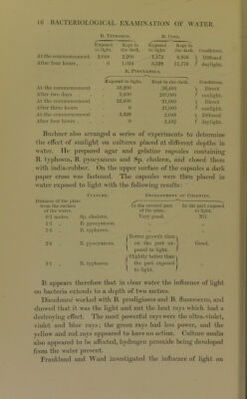
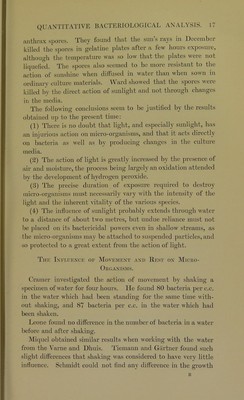
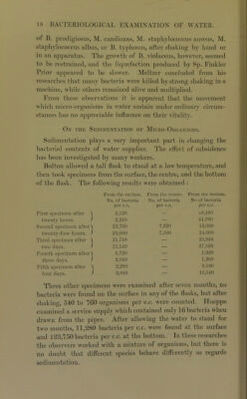
![n. Typhosus. B. CoLi. K.\pos(;il Kept in K.xposed Kept in to light. the (lark. to light. the dark. Conditlous. At the commencement. 2,048 2,200 1,472 9,856 I Diffused After four liours. 0 1,024 3,328 11,776 ; daylight. B. Pyocy ANKUH. ✓ ^ V Kx])osed to liglit. Ke])t in the dark. Conditions. At the commencement ;-)0,200 38,400 I Direct After two days . 9,600 269,000 j sunlight. At the commencement 22,000 21,000 \ Direct After tliree hours 0 21,000 s sunlight. At the commencement 3,328 2,048 1 Diffused After four hours . 0 2,4.32 / daylight. Buchner also arranged a series of experiments to determine the effect of sunlight on cultui’es placed at different depths in water. He prepared agar and gelatine capsules containing B. typhosus, B. pyocyaneus and Sp. cholerse, and closed them w'ith india-rubber. On the upper surface of the capsules a dark paper cross was fastened. The capsules were then placed in water exposed to light with the following results: Culture. Development of Colonies. Distance of tlie plate from the surface of the water. ^ In the covered part of the plate. In the ])art exposed to light. O’l metre. Sp. cholera;.. Very good. Nil. 1-1 .. B. pyocyaneus. - 1-6 .. B. typhosus. (Better growth thain 1 2-6 .. B. pyocyaneus. 4 on the part ex- V posed to light. J C Slightly better than) ^ Good. 1 3-1 ., B. typhosus. 4 the part exposed 1 to light. J It appears therefore that in clear water the influence of light on bacteria extends to a depth of two metres. Dieudonne worked with B. prodigiosus and B. fluorescens, and showed that it was the light and not the heat ra}'s which had a destroying effect. The most powerful rays were the ultra-violet, violet and blue rays; the green rays had less power, and the yellow and red rays appeared to have no action. Culture media also appeared to be affected, hydrogen peroxide being developed from the water present. Frankland and Ward investigated the influence of light on](https://iiif.wellcomecollection.org/image/b28116525_0052.jp2/full/800%2C/0/default.jpg)