An introduction to the bacteriological examination of water / by W.H. Horrocks.
- Horrocks, W. H. (William Heaton), Sir, 1859-
- Date:
- 1901
Licence: In copyright
Credit: An introduction to the bacteriological examination of water / by W.H. Horrocks. Source: Wellcome Collection.
54/356 page 18
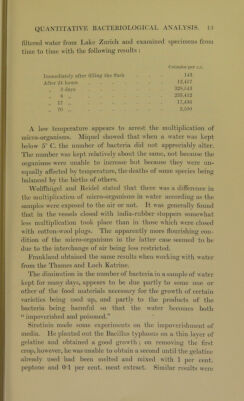
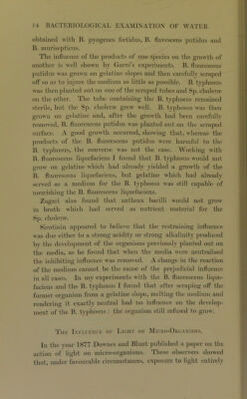
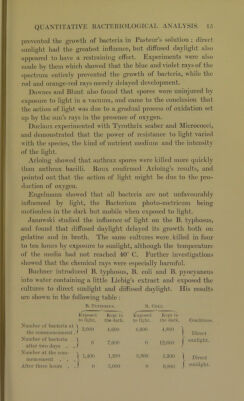
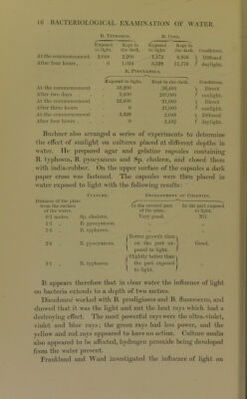
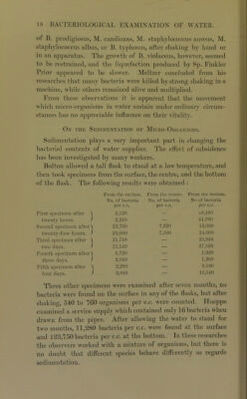
![of 13. prodigiosus, M. candicans, M. sta])hylococcus aureus, M. staphylococcus albus, or B. typhosus, after shaking by hand or in an apparatus. The growth of B. violaceus, howevei’, seemed to be restrained, and the liquefaction produced by Sp. Finkler Prior appeared to be slower. Meltzer concluded from his researches that many bacteria were killed by strong shaking in a machine, while others remained alive and multijdied. Fi'om these observations it is apparent that the movement Avhich micro-organisms in water sustain under ordinary circum- stances has no appreciable influence on their vitality. On the Sedimentation of Micro-Oiiganisjis. Sedimentation plays a very important part in changing the bactei’ial contents of water supplies. The effect of subsidence has been investigated by many workers. Bolton allowed a tall flask to stand at a low temperature, and then took specimens from the surface, the centre, and the bottom of the flask. The following results were obtained : From the surface. From tlie centre. From tile bottom. No. of bacteria No. of bacteria No of bacteria per c.c. per c.c. per c.c. First specimen after \ 2,120 — 48,460 twenty hours. J 2,240 — 44,080 Second specimen after \ 23,760 7,320 13,060 twenty-four hours. J 24,000 7,.500 14,000 Third specimen after \ 11,740 — 25,940 two days. J 11,140 — 27,520 Fourth specimen after \ 1,720 — 1,920 three days. J 2,040 — 1,200 Fifth specimen after \ 2,280 — 9,580 four days. J 3,840 — 10,549 Three other specimens were examined after seven months, no bacteria were found on the surface in any of the flasks, but after shaking, 540 to 760 organisms per c.c. were counted. Hueppe examined a service supply which contained only 16 bacteria when drawn from the pipes. After allowing the water to stand for two months, 11,280 bacteria per c.c. were found at the surface and 123,750 bacteria per c.c. at the bottom. In these researches the observers worked with a mixture of organisms, but there is no doubt that different species behave differently as regards sedimentation.](https://iiif.wellcomecollection.org/image/b28116525_0054.jp2/full/800%2C/0/default.jpg)