Licence: Public Domain Mark
Credit: The poetical works of Mark Akenside. Source: Wellcome Collection.
54/418
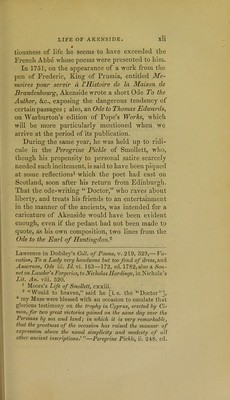
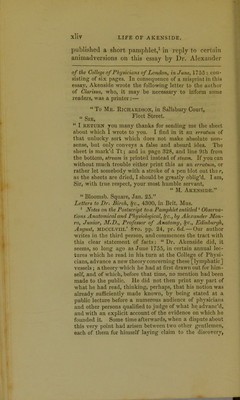
![published a short pamphlet,1 in reply to certain animadversions on this essay by Dr. Alexander of the College of Physicians of London, in June, 1755: con- sisting of six pages. In consequence of a misprint in this essay, Akenside wrote the following letter to the author of Clarissa, who, it may be necessary to inform some readers, was a printer:— “ To Mn. Richardson, in Salisbury Court, „ gJR Fleet Street. “ I return you many thanks for sending me the sheet about which I wrote to you. I find in it an erratum of that unlucky sort which does not make absolute non- sense, but only conveys a false and absurd idea. The sheet is mark’d 'ft; and in page 328, and line 9th from the bottom, stream is printed instead of steam. If you can without much trouble either print this as an erratum, or rather let somebody with a stroke of a pen blot out the r, as the sheets are dried, I should be greatly oblig’d. I am, Sir, with true respect, your most humble servant, “ M. Akenside.” “ Bloomsb. Square, Jan. 25.” Letters to Dr. Birch, §•<:., 4300, in Brit. Mus. 1 Notes on the Postscript to a Pamphlet entitled ‘ Observa- tions Anatomical and Physiological, §•<;., by Alexander Mon- ro, Junior, M.D., Professor of Anatomy, SfC., Edinburgh, August, JiDCCLvm.’ 8vo. pp. 24, pr. Gd. — Our author writes in the third person, and commences the tract with this clear statement of facts: “ Dr. Akenside did, it seems, so long ago as June 1755, in certain annual lec- tures which he read in his turn at the College of Physi- cians, advance a new theory concerning these [lymphatic] vessels; a theory which he had at first drawn out for him- self, and of which, before that time, no mention had been made to the public. He did not then print any part of what he had read, thinking, perhaps, that his notion was already sufficiently made known, by being stated at a public lecture before a numerous audience of physicians and other persons qualified to judge of what lie advanc’d, and with an explicit account of the evidence on which he founded it. Some time afterwards, when a dispute about this very point had arisen between two other gentlemen, each of them for himself laying claim to the discovery,](https://iiif.wellcomecollection.org/image/b24877062_0054.jp2/full/800%2C/0/default.jpg)




 No text description is available for this image
 No text description is available for this image
 No text description is available for this image