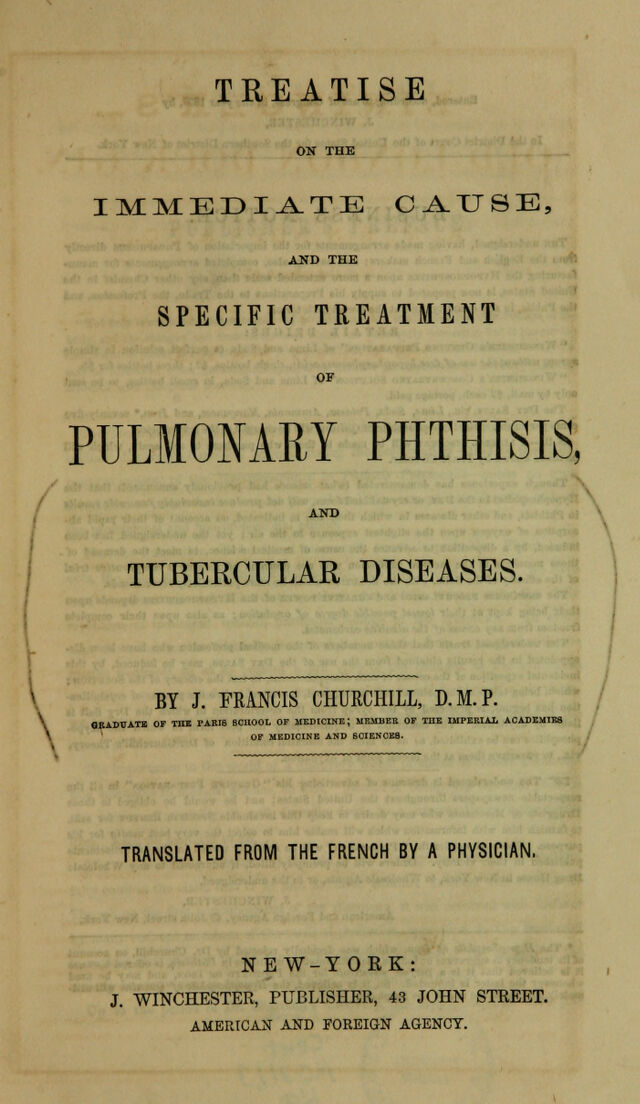
Treatise on the immediate cause, and the specific treatment of pulmonary phthisis : and tubercular diseases / by J. Francis Churchill.
- John Francis Churchill
- Date:
- [1859]
Licence: Public Domain Mark
Credit: Treatise on the immediate cause, and the specific treatment of pulmonary phthisis : and tubercular diseases / by J. Francis Churchill. Source: Wellcome Collection.
Provider: This material has been provided by the Harvey Cushing/John Hay Whitney Medical Library at Yale University, through the Medical Heritage Library. The original may be consulted at the Harvey Cushing/John Hay Whitney Medical Library at Yale University.
46/116 page 44
![left side where it is mixed with a few sibilant rales. The expiratory breathing on both sides is quite loud ; while, on the contrary, the inspiration is weak. The first sound of the heart is replaced by a harsh souffle, [a blowing sound,] followed by a softer one, which, however, does not completely hide 'the second sound. These sounds have their maximum at the base, and are prolonged in the direction of the arch of the aorta. The pulse is small and irregular. The diagnosis of this case was somewhat difficult: but after reflection, I made up my mind that the only way of explaining both the physical and constitutional symptoms, as well as the progress of the disease, was by adopting the following definition: Tubercles in the second stage, occupying tho whole of the apex of the right lung, with emphysema, and constriction of the aorta. Commenced treatment with the hypophosphite of potassa, in a dose of four grains; gave also ten drops of ethereal tincture of digitalis three times a day. June lMh.—Paroxysms of asthma have diminished in intensity and frequence; in every other respect is improving. Increased the dose to ten grains. August 21th,—Looks better in the face, but his lips are still purple; is well enough to attend to his business. On examination, I found the inspiratory murmur still very feeble, with prolonged increased expiration. The sounds of the heart still accompanied with a double souffle. The crepitation seems greater at the sum- mit of the right lung, and sound still more like a mucous rale. December 2'ilh.—My patient has been absent to this date. The physical signs are now about as they were in August, but the constitutional ones are less satisfac- tory. With the coming of cold weather, his cough has increased, his breathing become moro embarrassed, the asthma resumed its intensity. Commenced again with tho hypophosphite of potassa, which was continued up to my departure in March, 1856. At this date, the paroxysms of asthma were quite rare, his cough was slight, his strength and appetite good. The tubercular deposit at tho apex of the right lung was slowly softening; whilo the symptoms of asphyxia, evidenced by the blue color of his lips, and the rapidity of his respirations, were more increased. The Bounds of the heart were about as before. There is no oedema.* The only observation which I have to make upon this case, and one which I have made in several others, is, that the hypophosphite of potassa seems to have a special influence in increasing the expectoration, and hastening the softening of the tubercles. In this respect it resembles the salt of ammonia. The constitutional effects seem about the same as those of the hypophosphites of lime and soda. CASE NO. XII. Dofia E. R : 19 years old; born in Santiago de Cuba; married. Visited mc first at Havana, on December 1st, 1855.—She then gave mo the following statement: Her father Tho infiltration of serum into tho tissue of the lnng, carried to such an extent as to diminish its permeability to air. Dropsical swelling produced by tho accumulation of serous flnid in the interstices of the areolar texture.](https://iiif.wellcomecollection.org/image/b21030066_0046.jp2/full/800%2C/0/default.jpg)