The origins of the National Health Service : the medical services of the New Poor Law, 1834-1871 / by Ruth G. Hodgkinson.
- Hodgkinson, Ruth G.
- Date:
- 1967
Licence: Attribution-NonCommercial 4.0 International (CC BY-NC 4.0)
Credit: The origins of the National Health Service : the medical services of the New Poor Law, 1834-1871 / by Ruth G. Hodgkinson. Source: Wellcome Collection.
35/744 page 9
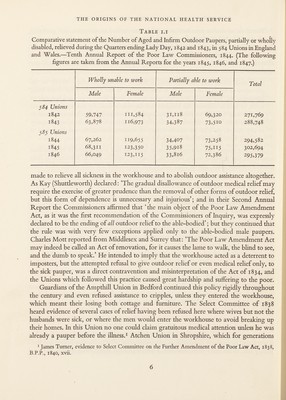
![this unfair advantage taken of them from fear of losing their appointment, which would be detrimental to their private practice. Therefore, in poor districts, the whole mass of the labouring population might be constituted medical paupers. Because the parish doctor could not afford to supply so large a class of patients with the best drugs and treatment, the 'indigent true poor', the 'legitimate objects of parish relief, had been made to suffer in the medical, as in other departments of relief, ' from the rash and indiscriminate attempt to extend the implications of the word poor to parties never contemplated by the ori ginal spirit of the poor law'. 1 It was for this reason that all the Assistant Commissioners recommended in their first reports that the primary object of any change in the system of providing medica] relief should be to diminish the liabilities of the medical contractor, by excluding those who had previously been improperly admitted to parish benefits. The first rule of the central authorities, therefore, directed Guardians to contract for attendance on paupers only, words which involved far greater changes in the administra tion of medical relief than was anticipated. In the Instructional Letter to various Boards of Guardians on their formation, 2 the Commissioners pointed out that poor rates were by law confined to the relief of absolute destitution, and that medical relief should not, as frequently assumed, be provided for the whole of the labouring classes. Although, they continued, it might appear at first sight that the application for medical relief should be treated with indulgence, yet a ' closer view of the causes and effects of pauperism would show that they would thereby produce evils of considerable magnitude'. Medical relief, they believed, operated as an easy introduction to further applications. They pointed to the districts which had 'correctly administered' medical relief, so that sick clubs and self- supporting dispensaries had rapidly increased, affording to the poor ' more efficient relief than could be hoped for by any form of parochial relief. When the Act had been in operation for only two years the Commissioners could confirm that the efficacy of such an arrangement had been proved. Their Second Annual Report stated that as relief was confined to the really destitute, the new system had already converted many paupers into independent labourers, and that they were providing against the contingency of medical pauperism through their clubs. The Assistant Commissioners, however, questioned whether the success of the pohcy was as rapid as had been hoped in reducing medical relief itself. Assistant Commissioner W. H. F. Hawley stated that there had been a general decrease in pauperism in Sussex, extensive beyond all expectations, but that he regretted he was unable to report 'medical relief as exhibiting a corresponding ratio of diminution'. He had tried to follow the instructions of the Poor Law Com missioners in attempting to abolish this species of relief to the able-bodied, but had found it difficult to overcome the deeply rooted and generally received opinion, entertained con currently by the Guardians, Medical Officers, and the poor, that the parish doctor was a sort of permanently established dispensary, to whom all the labouring classes had a right 1 Power's Report. Second Annual Report, 1836. 2 31 January 1837.](https://iiif.wellcomecollection.org/image/b20086325_0035.JP2/full/800%2C/0/default.jpg)