Lectures on mental disease.
- Sankey, W. H. O. (William Henry Octavius), 1813-1889.
- Date:
- 1884
Licence: Public Domain Mark
Credit: Lectures on mental disease. Source: Wellcome Collection.
Provider: This material has been provided by the Augustus C. Long Health Sciences Library at Columbia University and Columbia University Libraries/Information Services, through the Medical Heritage Library. The original may be consulted at the the Augustus C. Long Health Sciences Library at Columbia University and Columbia University.
48/486 page 24
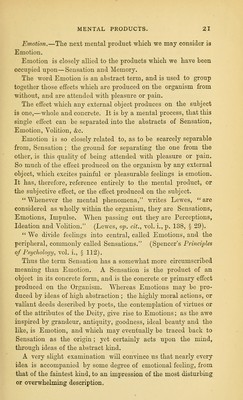
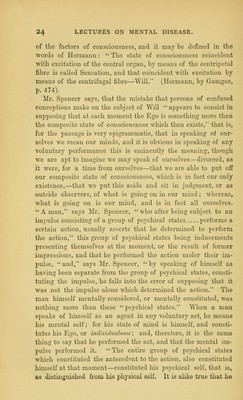
![of the factors of consciousness, and it may be defined in the words of Hermann : The state of consciousness coincident with excitation of tlie central organ, by means of the centripetal fibre is called Sensation, and that coincident with excitation by means of the centrifugal fibre—Will. (Hermann, by Gamgee, p. 474). Mr. Spencer says, that the mistake that persons of confused conceptions make on the subject of Will appears to consist in supposing that at each moment the Ego is something more than the composite state of consciousness which then exists, that is, for the passage is very epigrammatic, that in speaking of our- selves we mean our minds, and it is obvious in speaking of any voluntary performance this is eminently the meaning, though we are apt to imagine we may speak of ourselves —divorced, as it were, for a time from ourselves—that we are able to put off our composite state of consciousness, which is in fact our only existence,—that we put this aside and sit in judgment, or as outside observers, of what is going on in our mind; whereas, what is going on is our mind, and is in fact all ourselves. A man, says Mr. Spencer, who after being subject to an impulse consisting of a gi'oup of psychical states performs a certain action, usually asserts that he determined to perform the action, this group of psychical states being inducements presenting themselves at the moment, or the result of former impressions, and that he performed the action under their im- pulse, and, says Mr. Spencer, by speakmg of himself as having been separate from the group of psychical states, consti- tuting the impulse, he falls into the error of supposing that it was not the impulse alone which determined the action. The man himself me]itally considered, or mentally constituted, was nothing more than these psychical states. When a man speaks of himself as an agent in any voluntary act, he means his mental self; for his state of mind is himself, and consti- tutes his Ego, or indivUlualtwss; and, therefore, it is the same thing to say that he performed the act, and that the mental im- pulse performed it. The entire group of psychical states which constituted the antecedent to the action, also constituted himself at that moment—constituted his psychical self, that is, as distinguished from his physical self. It is alike true that he](https://iiif.wellcomecollection.org/image/b2120844x_0048.jp2/full/800%2C/0/default.jpg)