Malleus maleficarum / translated with an introduction, bibliography and notes by Montague Summers.
- Heinrich Kramer
- Date:
- 1948
Licence: Public Domain Mark
Credit: Malleus maleficarum / translated with an introduction, bibliography and notes by Montague Summers. Source: Wellcome Collection.
43/310 (page 17)
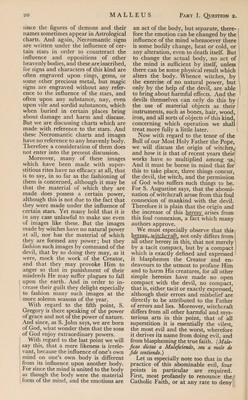
![enables them to bring about extra¬ ordinary and indeed evil effects without the aid of the devil. It must be under¬ stood that from one particular to con¬ clude a universal argument is contrary to all sound reason. And when, as it seems, throughout the whole of the Scriptures no such instance can be found, save where it speaks of the charms and spells old women practise, therefore we must not hence conclude that this is always the case. Moreover, the authorities on these passages leave the matter open to question, that is to say, whether such charms have any efficacy without the co-operation of the devil. These charms or fascinations seem capable of division into three kinds. First, the senses are deluded, and this may truly be done by magic, that is to say, by the power of the devil, if God permit it. And the senses may be enlightened by the power of good angels. Secondly, fascination may bring about a certain glamour and a leading astray, as when the apostle says: Who hath bewitched you? Galatians iii, 1. I In the third place, there may be a cer¬ tain fascination cast by the eyes* over another person, and this may be harm¬ ful and bad. And it is of this fascination that Avicenna and Al-Gazali have spoken; S. Thomas too thus mentions this fas¬ cination, Part 1, question 117. For he says the mind of a man may be changed by the influence of another mind. And that influence which is exerted over another often proceeds from the eyes, for in the eyes a certain subtle influence may be concentrated. For the eyes direct their glance upon a certain ob¬ ject without taking notice of other things, and although the vision be per¬ fectly clear, yet at the sight of some impurity, such as, for example, a woman during her monthly periods, the eyes will as it were contract a certain impurity. This is what Aristotle says in his work On Sleep and Waking, f and thus if anybody’s spirit be inflamed with malice or rage, as is often the case with old women, then their disturbed spirit * “Cast by the eyes.” In Ireland it was sup¬ posed that certain witches could cast a spell at a glance, and they were commonly called “'eye- biting witches.” t “On Sleeps This is one of the smaller treatises connected with Aristotle's great work “On the Soul, rcepi looks through their eyes, for their coun¬ tenances are most evil and harmful, and often terrify young children of tender! years, who are extremely impression-; able. And it may be that this is often natural, permitted by God; on the other hand, it may be that these evil looks are often inspired by the malice of the devil, with whom old witches have made some secret contract. The next question arises with regard to the influence of the heavenly bodies, and here we find three very common errors, but these will be answered as we proceed to explain other matters. With regard to operations of witch¬ craft, we find that some of these may be due to mental influence over others, and in some cases such mental influence might be a good one, but it is the motive which makes it evil. And there are four principal argu¬ ments which are to be objected against those who deny that there are witches, or magical operations, which may be performed at the conjunction of certain planets and stars, and that by the malice of human beings harm may be wrought through fashioning images, through the use of spells, and by the writing of mysterious characters. All theologians and philosophers agree that the heav¬ enly bodies are guided and directed by certain spiritual mediums. But those spirits are superior to our minds and souls, just as the heavenly bodies are superior to other bodies, and therefore they can influence both the mind and body of a man, so that he is persuaded and directed to perform some human act. But in order yet more fully to attempt a solution of these matters, we may consider certain difficulties from a discussion of which we shall yet more clearly arrive at the truth. First, spirit-j ual substances cannot change bodies to] some other natural form unless it be through the mediumship of some agent. Therefore, however strong a mental influence may be, it cannot effect any change in a man’s mind or disposition. Moreover, several universities, especially that of Paris, have condemned the fol¬ lowing article:—That an enchanter is able to cast a camel into a deep ditch merely by directing his gaze upon it. And so this article is condemned, that a corporeal body should obey some spiritual substance if this be understood simply, that is to say, if the obedience](https://iiif.wellcomecollection.org/image/b31349717_0043.jp2/full/800%2C/0/default.jpg)