Physiology of the nervous system / by J. P. Morat ; translated and edited by H. W. Syers.
- Jean-Pierre Morat
- Date:
- 1906
Licence: In copyright
Credit: Physiology of the nervous system / by J. P. Morat ; translated and edited by H. W. Syers. Source: Wellcome Collection.
56/716 (page 24)
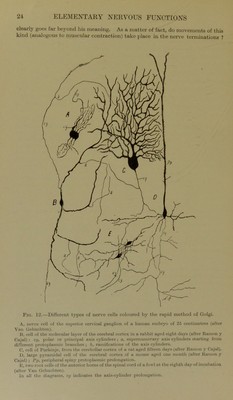
![clearly goes far bej-ond liis meaning. As a matter of fact, do movements of this kind (analogous to muscular contraction) take place in the nerve terminations ? Fig. 12.—Different types of nerve cells coloured by the rapid method of Golgi. A, ners'e cell of the superior cervical ganglion of a human embryo of 25 centimetres (after Van Uehuchten). B, cell of the molecular layer of the cerebral cortex in a rabbit aged eight days (after Ramon y Cajal) : cij, polar or ])rincipal axis cylinders ; a, supernumerary axis cylinders starting from different protO])la.smic branches ; 6, ramifications of the axis cylinders. C, cell of Purkinje, from the cerebellar cortex of a cat aged fifteen days (after Ramon y Cajal). D, large pyramidal cell of the cerebral cortex of a mouse aged one month (after Ramon y Cajal) ; Pp, peripheral spiny protoplasmic prolongation. E, two root cells of the anterior horns of the spinal cord of a fowl at the eighth day of incubation (after Van Gebuchten). In all the diagrams, cy indicates the axis-cylinder prolongation.](https://iiif.wellcomecollection.org/image/b28716851_0056.jp2/full/800%2C/0/default.jpg)