Physiology of the nervous system / by J. P. Morat ; translated and edited by H. W. Syers.
- Jean-Pierre Morat
- Date:
- 1906
Licence: In copyright
Credit: Physiology of the nervous system / by J. P. Morat ; translated and edited by H. W. Syers. Source: Wellcome Collection.
58/716 (page 26)
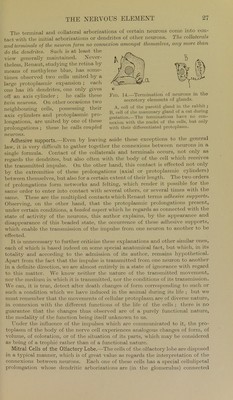
![whicli can be followed into the tissues in transparent animals show no visible movement. Functional dissociation ; Mechanism and localization.—Concerning the exis- tence of a nervous amoeboism properly so called, we have just made express reserves which are rendered necessary, we consider, by the want of precise infor- mation regarding the functional mechanism of the neui’on, and the difficulty of attributing a causal signification to the anatomical and experimental facts by which it has been attcmi)ted to explain this mechanism. Having made these reservations, we consider, nevertheless, that the fundamental idea on which this conception is based deserves to be weighed, and that there is something in it which is worthy of discussion. It is this idea which it is now necessary to evolve. The study of the nervous system displays it to us as presenting during its functional activity, dissociations and associations of its different parts, which are sometimes isolated the one from the other, sometimes united, according to the nature or the complexity of the act to be accom- plished. It being admitted as proved that such separations and recon- nexions arise in the nervous system, it is natural to suppose that a rupture and a renewal of the connexions between its several parts should be effected, especi- ally in that locality where its elements (nerve cells), in giving off their opposed prolongations, have first encountered each other in the course of their develop- ment in order to build up the system in its totality and the sub-systems which compose it.—Thus, in so far as these ])henomena of dissociation and association are localized at the extremity of the neurons (at tlieir points of contact), which the study of nerv'ous functions renders apjiarent, no risk of self-deception arises, whatever may be the modifications or the facts which the future may reveal as necessary to our present conceptiors with regard to the constitution of the nerve element. It .seems, indeed, that it is here (at the point of junction of tlie neurons) that the principal transformations which the impulse undergoes in passing through the grey matter take place. Fundamentally, what is generally described as a centre is merely a locality where the neurons are able to organize themselves into a definite system (partial) in order to perform a definite function. But to this problem of localisation another is added, concerning the intimate mechanism of the transformation brought about in the grey matter every time that its organization adapts itself to the performance of a special act. Ho the breaks and the union between neurons consist in mechanical and visible disidacement, or in molecular movements which our oiitical appliances do not permit us to recognize ? At the present time it is impossible to express a definite opinion on this question. Dissociations and associations between nerve elements certainly exist; in all probability they may be localized in the grey matter at the points of junction of the nerve elements. No definite state- ment can be made concerning the mechanism by which they are carried out. Nevertheless, as mechanical phenomena jiroperly so called are those winch are most easily comprehended, as they are those which, in the study of every function have always contributed to furnish the first intelligible ideas, the doctrine 6i amoeboism, by clearly defining the question of the connexions between nerve elements, indicates progress in the study of nervous physiology. From another point of view, it has led to the production of works and to the determination of facts which, however obscure their signification may be at the present time, are yet of great interest. • ■ „ j Connexions of the Neurons.-The individuality of the neurons Pro^ed , it is founded on the idea of their exact limitation and of their independent life It remains to ascertain the mode of connexion which exists between them am the other tissues. On this point it may be said that scarcely anything is known. Whether in the purely static condition, or whether m the dynamic condition, the data we possess concerning these connexions are very incomplete.](https://iiif.wellcomecollection.org/image/b28716851_0058.jp2/full/800%2C/0/default.jpg)