Physiology of the nervous system / by J. P. Morat ; translated and edited by H. W. Syers.
- Jean-Pierre Morat
- Date:
- 1906
Licence: In copyright
Credit: Physiology of the nervous system / by J. P. Morat ; translated and edited by H. W. Syers. Source: Wellcome Collection.
698/716 (page 666)
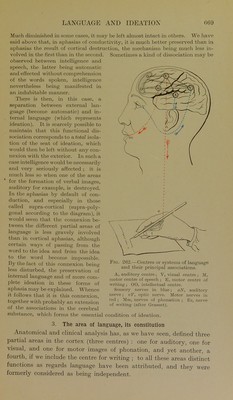
![sensorical or motor, Avhich take part in tlie function of language. It is even generally maintained that these images are included therein. I his manner of projioimding the localization of language and its prin- ci])al mechanisms goes beyond the ascertained facts. These latter incontestably prove that each of these regions is an essential portion of the nervous mechanism of language. But this mechanism is capable of being changed and arrested as regards its function by lesions other than those of the cortex, bor aphasia to be produced, it is necessary and sufficient that the principal associations presiding over the function of language be interrupted. In some points this rupture is brought about by the destruction of certain regions of the cortex ; but it may also be induced by interruption of the white tracts, whose definite function it is to mutually associate these regions, or by that of the fibres of projection terminating in them or immediately leaving them. These are called the aphasias of conductivity. Essential difference.—The symptomatological difference lies in the important fact, that internal language, corresponding to the loss of the images whence aphasia results, is then preserved. There is no oblitera- tion of an order or a form of images, but rupture of the connexions which must normally exist between these images for speech or for writing to be properly carried out. To put it otherwise, the internal organization of the partial systems which ensure the formation of motor or sensorial images (organization carried out by the above-mentioned regions of the grey matter) is not compromised, but there is a separation of these different systems, together with the impossibility of uniting in common functions for the future (associations effected by certain fibres extending in a large number from one to the other of these regions through the white matter). Injuries affecting the region of the insula, situated immediately between the regions called sensorial and those called motor, produce aphasia of this nature by section of the white tracts of association passing through it (Dejerine). Schematic constructions.—Charcot, Lichteim, Grasset, and several other authors have constructed schemes intended to facilitate the comprehension of the mechanism of language, as well as its disturbance in different aphasias. That of Grasset, inasmuch as it aims less at the clinical reality of the different disturb- ances observed, is the one most appropriate for the concrete representation of the different questions discussed vdth regard to the analysis of language in its normal or disturbed condition. By connecting together the four cortical centres {two for sensation, two for motion) which preside over this function, a sort of horizontal polygon is produced, of which these areas of the cortex form tlie angles. From these same angles start ascending vertical lines, to represent the sensorial nerves, and descending lines for the motor nerves. By the associations here produced between sensation and movement, this polygon ensures both the physio- logical and psychological automatism of the functions of language. But these](https://iiif.wellcomecollection.org/image/b28716851_0698.jp2/full/800%2C/0/default.jpg)