Mercury compounds of hydroxybenzaldehydes / by Thomas Anderson and Thomas Marvel Sharp.
- Thomas Anderson Henry
- Date:
- [1922.]
Licence: Public Domain Mark
Credit: Mercury compounds of hydroxybenzaldehydes / by Thomas Anderson and Thomas Marvel Sharp. Source: Wellcome Collection.
7/12 page 1059
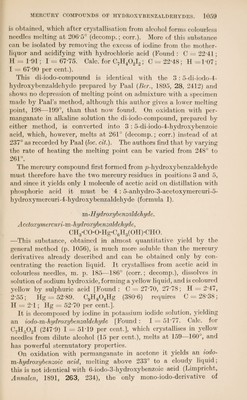
![is obtained, which after crystallisation from alcohol forms colourless needles melting at 200-5° (decomp.; corr.). More of this substance can be isolated by removing the excess of iodine from the mother- liquor and acidifying with hydrochloric acid (Found : C = 22 41; H = 1-91; I = 07-75. Calc, for C7H402I2; C = 22-48; H =107; I = 07-90 per cent.). This di-iodo-compound is identical with the 3 : 5-di-iodo-4- hydroxybcnzaldehyde prepared by Paal (Ber., 1895, 28, 2412) and shows no depression of melting point on admixture with a specimen made by Paal’s method, although this author gives a lower melting point, 198—199°, than that now found. On oxidation with per¬ manganate in alkaline solution the di-iodo-compound, prepared by either method, is converted into 3 : 5-di-iodo-4-hydroxybenzoic acid, which, however, melts at 261° (decomp.; corr.) instead of at 237° as recorded by Paal (loc. cit.). The authors find that by varying the rate of heating the melting point can be varied from 248° to 261°. The mercury compound first formed from p-hydroxybenzaldehyde must therefore have the two mercury residues in positions 3 and 5, and since it yields only 1 molecule of acetic acid on distillation with phosphoric acid it must be 4 : 5-anhydro-3-acetoxymercuri-5- hydroxymcrcuri-4-hydroxybenzaldehyde (formula 1). m-Hydroxybenzaldehyde. A cetoxyme rcuri-m - hydroxybcnzaldchyde, CH3*C0-0-Hg*C6H3(0H)-CH0. —This substance, obtained in almost quantitative yield by the general method (p. 1056), is much more soluble than the mercury derivatives already described and can be obtained only by con¬ centrating the reaction liquid. It crystallises from acetic acid in colourless needles, m. p. 185—186° (corr.; decomp.), dissolves in solution of sodium hydroxide, forming a yellow liquid, and is coloured yellow by sulphuric acid [Found : C = 27*70, 27*78; H = 2'47, 2*55; Hg = 52-89. C9H804Hg (380*6) requires C = 28-38; H = 2-1; Hg = 52-70 per cent.]. It is decomposed by iodine in potassium iodide solution, yielding an iodo-m-hydroxybenzaldchyde [Found : I = 51*77. Calc, for C7H502I (247-9) I = 51*19 per cent.], which crystallises in yellow needles from dilute alcohol (15 per cent.), melts at 159—160J, and has powerful sternutatory properties. On oxidation with permanganate in acetone it yields an iodo- m-hydroxybenzoic acid, melting above 233° to a cloudy liquid; this is not identical with 6-iodo-3-hydroxybenzoic acid (Limpricht, Annalen, 1891, 263, 234), the only mono-iodo-derivative of](https://iiif.wellcomecollection.org/image/b30623467_0007.jp2/full/800%2C/0/default.jpg)


 No text description is available for this image
 No text description is available for this image
 No text description is available for this image