Licence: Public Domain Mark
Credit: Sales catalogue 533: Maggs Bros. Source: Wellcome Collection.
20/294 page 4
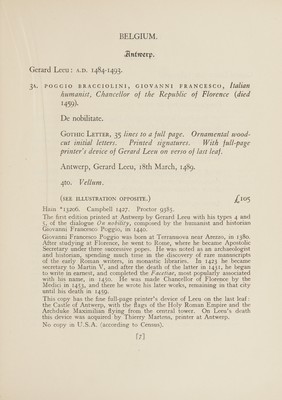
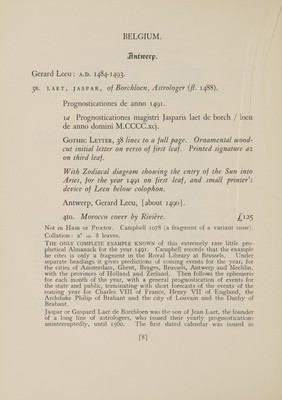
![Dienna. Johann of Winterburg : c. 1492-1500 (-1519). The exact dates during which Johann of Winterburg was working have not been ascertained, but his farst book was an edition of Perseus in 1492, and he appears to have gone on printing till within a short time before his death, in 1519. With the exception of two German tracts he was a Latin printer, working chiefly for the church (service-books and the like), and for students. Johann of Winterburg employed woodcuts for illustration from 1496 inwards, chiefly of small size, which appeared on the title-pages of his works. In 1499 he brought out two Requiem Missals, which were illustrated with a fine and beautiful initial T’, representing a priest saying Mass, while behind him stand six figures, and tc his right is a kneeling woman. Johann of Winterburg employed two devices, the earlier consisting of a circle enclosing a serpent coiled round an arrow, with the printer’s initials, “I. W.” on either side, and above, a cross flanked by two mythological figures. ‘This was later simplified, and appeared in 1500 without the figures and in white on red, instead of in red on a white background as the former was. 3. AUSONIUS, DECIMUS MAGNUS, Roman poet (4th Century). Sodalitas Litteraria Germaniae. Gortuic Letter, 39 lines to a full page. Lombardic initials. Some initial spaces. Printed signatures (numerals without a letter). With spaces for Greek words. Vienna, [Johann of Winterburg| ductu Conradi Celtis, 1500. 4to. Full levant morocco, by kiviere. £85 Hain 2182. \Proctor'9477..- British Museum Cat. incum,, Vol. Iiijip. Sit. A rare edition of a collection of poems written by the Roman poet Ausonius, the son of Julius Ausonius, a physician of Bordeaux. He early gave proof of genius and was appointed tutor to Gratian, the son of the Emperor Valerian, who, on his succession to the throne, created his former tutor praetorian prefect of Gaul, and later raised him to the Consulship. On the verso of leaf vi is a neatly written MS. couplet, a ‘‘ Distichon Chunradi Celtis.’ The copy is in nice condition, and is one of several similar little works which Johann of Winterburg printed for the use of Greek and Latin students. [4]](https://iiif.wellcomecollection.org/image/b31814323_0020.jp2/full/800%2C/0/default.jpg)
 No text description is available for this image
 No text description is available for this image
 No text description is available for this image