The influence of sodium benzoate on the nutrition and health of man.
- United States. Department of Agriculture. Referee Board of Consulting Scientific Experts.
- Date:
- 1909
Licence: Public Domain Mark
Credit: The influence of sodium benzoate on the nutrition and health of man. Source: Wellcome Collection.
Provider: This material has been provided by the Augustus C. Long Health Sciences Library at Columbia University and Columbia University Libraries/Information Services, through the Medical Heritage Library. The original may be consulted at the the Augustus C. Long Health Sciences Library at Columbia University and Columbia University.
20/834 page 14
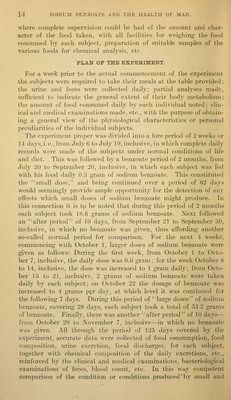
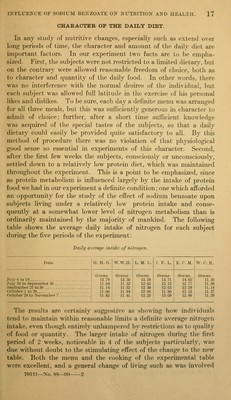
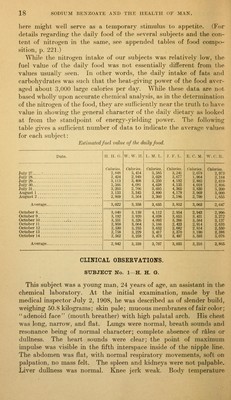
![where complete supervision could be had of the amount and char- acter of the food taken, with all facilities for weighing the food consumed b}^ each subject, ])reparation of suitable samples of the various foods for chemical analysis, etc. PLAN OF THE EXPERIMENT. For a week prior to the actual commencement of the experiment the subjects were required to take their meals at the table provided; the urine and feces were collected daily; partial analyses made, sufficient to indicate the general extent of their body metabolism; the amount of food consumed daily by each individual noted; clin- ical and medical examinations made, etc., with the purpose of obtain- ing a general view of the physiological characteristics or personal peculiarities of the individual subjects. The experiment proper was divided into a fore periotl of 2 weeks or 14 daj^s,i.e.,from July 6 to July 19, inclusive, in which complete daily records were made of the subjects under normal conditions of life and diet. This was followed by a benzoatc period of 2 months, from July 20 to September 20, inclusive, in which each subject was fed with his food daily 0.3 gram of sodium benzoate. This constituted the small dose, and being continued over a period of 62 days would seemingl}^ provide ample opportunity for the detection of any effects which small doses of sodium benzoate might produce. In this connection it is to be noted that during this period of 2 months each subject took 18.6 grams of sodium benzoate. Next followed an after period of 10 days, from September 21 to September 30, inclusive, in which no benzoate was given, thus affording another so-called normal period for comparison. For the next 4 weeks, commencing with October 1, larger doses of sodium benzoate were given as follows: During the first week, from October 1 to Octo- ber 7, inclusive, the daity dose was 0.6 gram; for the week October 8 to 14, inclusive, the dose was increased to 1 gram daih^; from Octo- ber 15 to 21, inclusive, 2 grams of sodium benzoate were taken daily by each subject; on October 22 the dosage of benzoate was increased to 4 grams per da}^, at which level it was contiinied for the following 7 days. During this period of large doses of sodium benzoate, covering 28 days, eacli subject took a total of 53.2 grams of benzoate. Finally, there was another after period of 10 days— from October 29 to November 7, inclusive—in which no benzoate was given. All through the period of 125 days covered by the experiment, accurate data were collected of food consumption, food composition, urine excretion, fecal discharges, for each subject, together with chemical composition of the daily excretions, etc., reinforced by the clinical and medical examinations, bacteriological examinations of feces, blood count, etc. In this way competent comparison of the condition or conditions produced by small and](https://iiif.wellcomecollection.org/image/b21230092_0020.jp2/full/800%2C/0/default.jpg)
 No text description is available for this image
 No text description is available for this image
 No text description is available for this image