The influence of sodium benzoate on the nutrition and health of man.
- United States. Department of Agriculture. Referee Board of Consulting Scientific Experts.
- Date:
- 1909
Licence: Public Domain Mark
Credit: The influence of sodium benzoate on the nutrition and health of man. Source: Wellcome Collection.
Provider: This material has been provided by the Augustus C. Long Health Sciences Library at Columbia University and Columbia University Libraries/Information Services, through the Medical Heritage Library. The original may be consulted at the the Augustus C. Long Health Sciences Library at Columbia University and Columbia University.
21/834 page 15
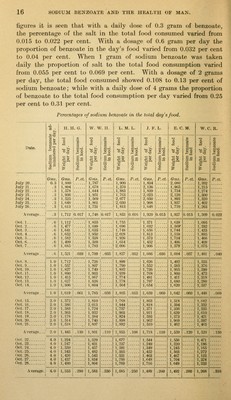
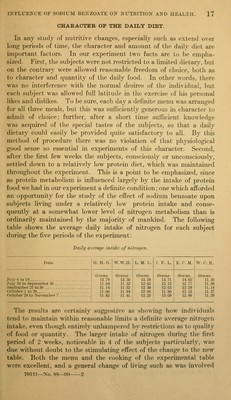
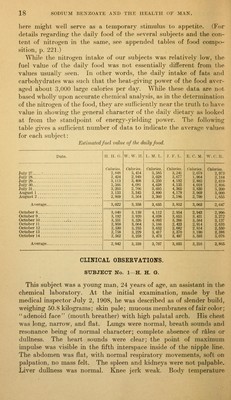
![large doses of sodium luMizoate, with llic iiornuil condition of tiie same subjects, mi<:cbt hv expected, and thus H<,dit l)e thrown upon the effects ol' sodium henzoate on liealtliy individmils. ADMINISTRATION OF THE SODIUM BENZOATE. In the administration of the henzoate an attemi)t was made to imitate the manner in which the salt would be taken if used in food as a preservative. Witli the smaller dose of 0.3 gram per day, tlie salt was dissolved in a iz;iven amount of water and then added to some one food so that the latter would contain one-tenth of 1 per cent of sodium henzoate. The salt was given three times a day— 0.1 gram of henzoate with each meal—and in some one article of food, where it would be present to the extent of about one-tenth of 1 per cent by weight of that food. In this way was avoided any possible local effect of a ndatively hirge single dose, as might per- haps ha])pen if administered by capsule. Further, this method of administration insured entrance into the stomach of essentially the same percentage of benzoate, even when the dosage was increased to 0.6 gram per day. With larger doses of sodium benzoate the same general method of procedure was followed, thougli with a daily dosage of 2 grams and over the amount of benzoate in the food rose necessarily above 0.1 per cent. A w^ord of explanation may ])e offered here regarding the size of the small dose of sodium l)enzoate em])loyed in our experiment. In adopting 0.3 gram of the salt as the dail}^ dose we were influenced by the bearing of our problem upon the practical question of the use of sodium l)enzoate as a food preservative. Manufacturers of food products requiring the use of a preservative are apparently content with an allowance of 0.1 per cent of sodium benzoate. The consumer of such a product would need to take 300 grams—nearly two-thirds of a pound—of such a preserved food per day to ingest an amount of sodium benzoate equal to our minimal daily dosage. In other words, looked at from this stand])oint, our dosage of 0.3 gram per day seemed a fair amount for a small dose, one that would clearly suffice to show any effect that small doses of the salt might exert, especially if continued for a reasonable length of time. In this connection it is interesting to note the relationship between the ingested sodium benzoate and the total food consumption of our different subjects per day during the several benzoate periods. The following table, giving the total amount of food consumed per day, together with tlie dosage of benzoate, shows the percentage of Ix^nzoate in the total day's food of the six subjects. From these « The sodium benzoate employed was soda benzoate, T'^. S. P., 99 per cent. It contained a trace of calcium and 2.2 per cent of water. In giving the salt, allow- ance was made for 99 per cent pure and the contained water, so that the daily doses specified represent actual sodium benzoate.](https://iiif.wellcomecollection.org/image/b21230092_0021.jp2/full/800%2C/0/default.jpg)
 No text description is available for this image
 No text description is available for this image
 No text description is available for this image