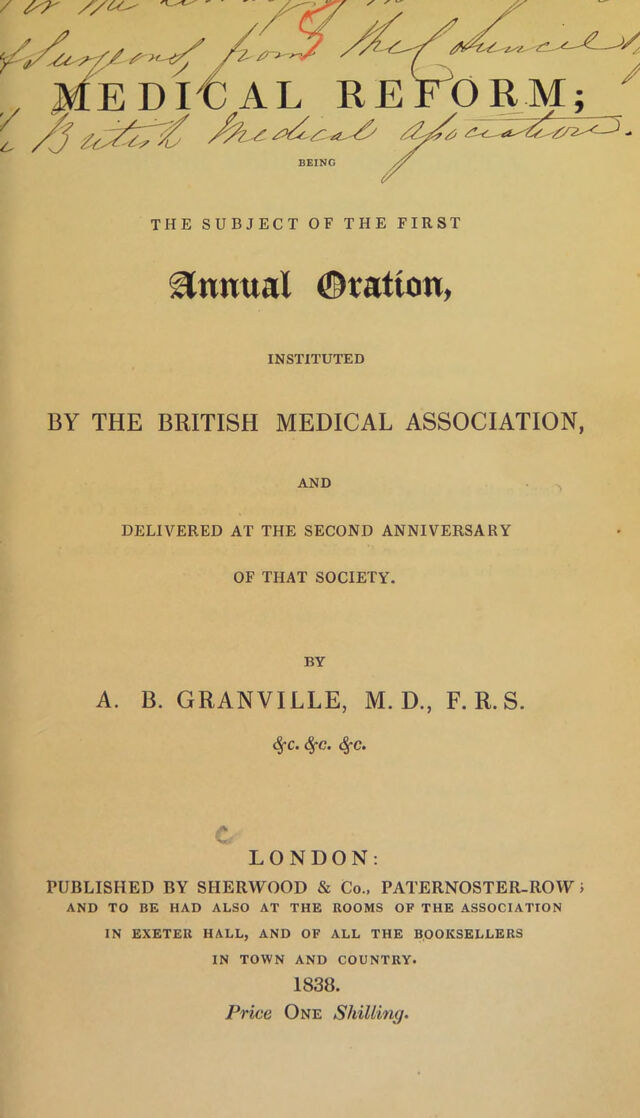
Medical reform : being the subject of the first annual oration, instituted by the British Medical Association, and delivered at the second anniversary of that society / by A.B. Granville.
- Augustus Granville
- Date:
- 1838
Licence: Public Domain Mark
Credit: Medical reform : being the subject of the first annual oration, instituted by the British Medical Association, and delivered at the second anniversary of that society / by A.B. Granville. Source: Wellcome Collection.
Provider: This material has been provided by The Royal College of Surgeons of England. The original may be consulted at The Royal College of Surgeons of England.
9/54 page 9
![many haunts of corrupt practices, and many features of deformity, among which the medical bodies-politic in the three kingdoms of these realms appear con- spicuously prominent. Like the great charter of Political Reform—our own will come at last : but it must be sought for and ob- tained by the like means—the general voice of those who require and are to be benefited by its accomplish- ment. The whole, or the larger part, of our medical brethren must join in the demand. Without this general support no such act will ever be obtained. Some few individuals there have always been, even among medical men, in this coun- try, as was the case with the politicians, anxiously de- siring, and struggling to obtain, the abolition of abuses, the rectification of errors, and the removal of corrup- tion ; and those individuals belonged to the better- instructed classes of the profession. Within the last fifty years, physicians and surgeons, some single- handed, others combined, though in small numbers, have appeared, from time to time, in the pursuit of those cherished objects. But those single individuals, and those select few, had to cope with the influence of patronage and high offices, which silenced every ex- pression of cordiality in the many. They had to cope with the power of bestowing places, and with leaders who made themselves strong in the support of influential and easily-deceived patients occupying the first charges in the state. They had to cope with the disinclination felt by the largest number of their or- der, against interfering witli any existing arrangement; as well as with the indifference of the tliousands of their brethren whom a ])rolonged war had provided](https://iiif.wellcomecollection.org/image/b22342552_0011.jp2/full/800%2C/0/default.jpg)