Volume 1
A general dictionary of arts and sciences: or a complete system of literature ... Poetry ... and theology / by ... James Scott ... The mathematical branches by Mr. Charles Green ... Naval and marine affairs ... by Mr. William Falconer ... Botany and gardening, by Mr. James Meader ... And the other branches of literature, by a society of gentlemen.
- Date:
- 1765-1766
Licence: Public Domain Mark
Credit: A general dictionary of arts and sciences: or a complete system of literature ... Poetry ... and theology / by ... James Scott ... The mathematical branches by Mr. Charles Green ... Naval and marine affairs ... by Mr. William Falconer ... Botany and gardening, by Mr. James Meader ... And the other branches of literature, by a society of gentlemen. Source: Wellcome Collection.
83/990
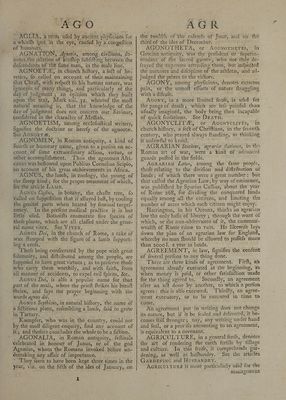
![7 AGIIA, a terth ufed by ancient phyficians for a whitifh fpot in the eye, caufed by a congeftion of humours. ~ | Ap notes the relation of kinfhip fubfifting between the defcendants of the fame man, in the male line. AGNOET 2, in church hiftory, a fee of he- retics,. fo. called on account. of their maintaining that Chtift, with refpe&t to his human nature, was ignorant of many things, and particularly of the day of judgment ; an opinion which they built upon the text, Mark xiii. 32, whereof the moft natural meaning is, that the knowledge of the day of judgment does not concern our Saviour, confidered in the character of Meffiah. _ AGNOETISM, ainong ecclefiaftical writers, fignifies the doétrine or herefy of the agnoete. See AGNOETA. AGNOMEN, in Roman antiquity, a kind of fourth or honorary name, given to a perfon on ac- count of fome extraordinary action, virtue, or other accomplifhment. Thus the agnomen Afri- canus was beftowed upon Publius Cornelius Scipio, on account of his great atchievements in Africa. AGNUS, the lamb, in zoology, the young of the fheep kind ; for the proper treatment of which, fee the article Lamp. Acunus Ca/flus, in botany, the chafte tree, fo called on fuppofition that it allayed luft, by cooling the genital parts when heated by feminal turgef- cency. In the prefent medical practice it is but little ufed. Botanifts enumerate five fpecies of thefe plants, which are all, clafled under the gene- ral name vitex. See VITEXx. AGnus De, in the church of Rome, a cake of wax ftamped with the figure of a lamb fupport- ing a crofs, Thefe being confecrated by the pope with great folemnity, and diftributed among the people, are fuppofed to have great virtues ; as to preferve thofe who carry them worthily, and with faith, from all manner of accidents, to expel evil {pirits, &c. Acnus Dei, is alfo a popular name for that part of the mafs, where the prieft {trikes his breaft thrice, and fays the prayer beginning with the words agnus det, y a fictitious plant, refenibling a lamb, faid to grow in Tartary. _ Kempfer, who was in the country, could not by the moft diligent enquiry, find any account of it; and thefore concludes the whole to be a fiction. AGONALTA, in Roman antiquity, feftivals celebrated in honour of Janus, or of the god Agonius, whom the Romans invoked before un- dertaking any affair of importance. ' ‘They feem to have been kept three times in the year, viz, on the fifth of the ides of January, on x ak: AGR the twelfth of “the calends of June, and on ‘thé third of the ides of December. AGONOTHETA,. or AcGonoTHETEs, in Grecian antiquity, was the prefident or fupetin- tendant of the facred games; who not only de- frayed the expences attending them, but imfpected the manners and difcipline of the athletae, and ad- judged the prizes to the victors. AGONY, among phyficians, denotes extreme pain, or the utmoft efforts of nature frugelin: with a difeafe. AGowy, in a more limited fenfe, is ufed for the pangs of death; which are lefs painful than ufually imagined, the body being then incapable of quick fenfations. .See DEATH. AGONYCLIT A, or AGoNYCLITES, ‘in church hiftory, a fe& of Chriftians, in the feventh century, who prayed always flanding, as thinking it unlawful to kneel. AGRARIAN Stations, agrarize flationes, in th® guards pofted in the fields. Acrarian Laws, among the fame people, thofe relating to the divifion and diftribution of lands ; of which there were a great number: but was publifhed by Spurius Caffius, about the year of Rome 268, for dividing the conquered lands equally among .all.the citizens, and limiting the number of acres which each citizen might enjoy. Harrington, in his Oceana, thinks an agrarian law the only bafis of liberty ; through the want of which, or the non-obfervance of it, the common- wealth of Rome came to ruin. He likewife lays down the plan of an agrarian law for’ England, whereby no man fhould be allowed to poflefs more than 20001]. -a year in lands. AGREEMENT, in law, fignifies the confent of feveral perfons to any thing done. There are three kinds of agreement. Firft, an agreement already executed at the beginning, as when money is paid, or other fatisfaction made for the thing agreed to. Secondly, an agreement after an act done by another, to which a perfon agrees: this is alfoexecuted. ‘Thirdly, an agree- ment executory, or to be executed in time to come, An agreement put ‘in writing does not change its nature, but if it be fealed and delivered, it be- comes {till ftronger; nay, any writing under hand and feal, or a provifo amounting to an agreement, is equivalent to a covenant. AGRICULTURE, in a general fenfe, denotes the art of rendering the earth fertile by tillage and culture. In this fenfe, it comprehends gar- dening, as well as hufbandry. See the articles GARDENING and HUSBANDRY. AGRICULTURE is more particularly ufed for the management](https://iiif.wellcomecollection.org/image/b3041393x_0001_0083.jp2/full/800%2C/0/default.jpg)
 No text description is available for this image
 No text description is available for this image
 No text description is available for this image