A treatise on the diseases of children : with directions for the management of infants from the birth / by Michael Underwood, M.D. ... ; with notes by a physician of Philadelphia ; three volumes in one ; vol. I[-III] ; from the sixth London edition.
- Michael Underwood
- Date:
- 1818
Licence: Public Domain Mark
Credit: A treatise on the diseases of children : with directions for the management of infants from the birth / by Michael Underwood, M.D. ... ; with notes by a physician of Philadelphia ; three volumes in one ; vol. I[-III] ; from the sixth London edition. Source: Wellcome Collection.
Provider: This material has been provided by the National Library of Medicine (U.S.), through the Medical Heritage Library. The original may be consulted at the National Library of Medicine (U.S.)
36/406
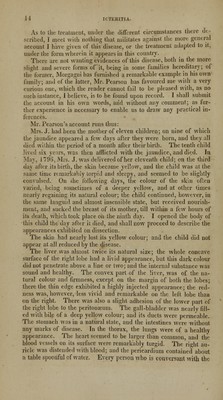
![As to the treatment, under the different circumstances there de- scribed, I meet with nothing that militates against the more general account I have given of this disease, or the treatment adapted to it, under the form wherein it appears in this country. There are not wanting evidences of this disease, both in the more slight and severe forms of it, being in some families hereditary; of the former, Morgagni has furnished a remarkable example in his own family; and of the latter, Mr. Pearson has favoured me with a very curious one, which the reader cannot fail to be pleased with, as no such instance, 1 believe, is to be found upon record. I shall submit the account in his own words, arid without any comment; as fur- ther experience is necessary to enable us to draw any practical in- ferences. Mr. Pearson's account runs thus: Mrs. J. had been the mother of eleven children; on nine of which the jaundice appeared a few days after they were born, and they all died within the period of a month after their birih. The tenth child Jived six years, was then afflicted with the jaundice, and died. In Mar, 1795, Mrs. J. was delivered of her eleventh child; on the third da] after its birth, the skin became yellow, and the child was at the same time remarkably lorpid and sleepy, and seemed to be slightly convulsed. On the following days, the colour of the skin often varied, being sometimes of a deeper yellow, and at other times nearly regaining its natural colour; the child continued, however, in the same languid and almost insensible state, but received nourish- ment, and sucked the breast of its mother, till within a few hours of its death, which took place on the ninth day. I opened the body of this child the day after it died, and shall now proceed to describe the appearances exhibited on dissection. The skin had nearly lost its yellow colour; and the child did not appear at all reduced by the disease. The liver was almost twice its natural size; the whole concave surface of the right lobe had a livid appearance, but this dark colour did not penetrate above a line or two; and the internal substance was sound and healthy. The convex part of the liver, was of the na- tural colour and firmness, except on the margin of both the lobes; there the thin edge exhibited a highly injected appearance; the red- ness was, however, less vivid and remarkable on the left lobe than on the right. There was also a slight adhesion of the lower part of the right lobe to the peritonaeum. The gall-bladder was nearly fill- ed with bile of a deep yellow colour; and its ducts were permeable. The stomach was in a natural state, and the intestines were without any marks of disease. In the thorax, the lungs were of a healthy appearance. The heart seemed to be larger than common, and the blood vessels on its surface were remarkably turgid. The right au- ricle was distended with blood; and the pericardium contained about a table spoonful of water. Every person who is conversant with the](https://iiif.wellcomecollection.org/image/b2116082x_0036.jp2/full/800%2C/0/default.jpg)