An historical survey of the astronomy of the ancients / by Sir George Cornewall Lewis.
- George Cornewall Lewis
- Date:
- 1862
Licence: Public Domain Mark
Credit: An historical survey of the astronomy of the ancients / by Sir George Cornewall Lewis. Source: Wellcome Collection.
Provider: This material has been provided by the Harvey Cushing/John Hay Whitney Medical Library at Yale University, through the Medical Heritage Library. The original may be consulted at the Harvey Cushing/John Hay Whitney Medical Library at Yale University.
444/548 page 430
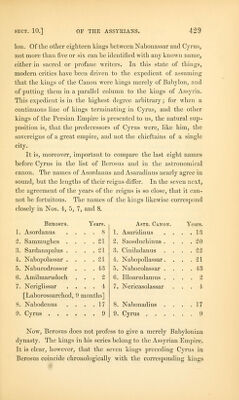
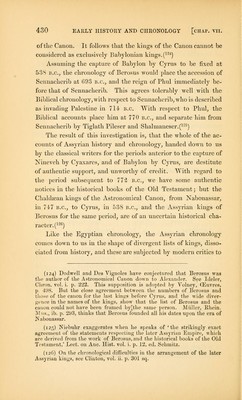
![of the Canon. It follows that the kings of the Canon cannot be considered as exclusively Babylonian kings.(124) Assuming the capture of Babylon by Cyrus to be fixed at 538 b.c.j the chronology of Berosus would place the accession of Sennacherib at 693 B.C., and the reign of Phul immediately be- fore that of Sennacherib. This agrees tolerably well with the Biblical chronology, with respect to Sennacherib, who is described as invading Palestine in 714 B.C. With respect to Phul, the Biblical accounts place him at 770 B.C., and separate him from Sennacherib by Tiglath Pileser and Shalmaneser.(125) The result of this investigation is, that the whole of the ac- counts of Assyrian history and chronology, handed down to us by the classical writers for the periods anterior to the capture of Nineveh by Cyaxares, and of Babylon by Cyrus, are destitute of authentic support, and unworthy of credit. With regard to the period subsecuient to 772 B.C., we have some authentic notices in the historical books of the Old Testament; but the Chaldsean kings of the Astronomical Canon, from Nabonassar, in 747 b.c, to Cyrus, in 538 B.C., and the Assyrian kings of Berosus for the same period, are of an uncertain historical cha- racter^120) Like the Egyptian chronology, the Assyrian chronology comes down to us in the shape of divergent lists of kings, disso- ciated from history, and these are subjected by modern critics to (124) Dodwell and Des Vignoles have conjectured that Berosus was the author of the Astronomical Canon down to Alexander. See Ideler, Chron. vol. i. p. 222. This supposition is adopted by Volney, (Euvres, p. 498. But the close agreement between the numbers of Berosus and those of the canon for the last kin^s before Cyrus, and the wide diver- gence in the names of the kings, show that the list of Berosus and the canon could not have been framed by^tke same person. Midler, Bhein. Mus., ib. p. 293, thinks that Berosus founded all his dates upon the era of ]NTabonassar. (125) Niebuhr exaggerates when lie speaks of 'the strikingly exact agreement of the statements respecting the later Assyrian Empire, which are derived from the work of Berosus, and the historical books of the Old Testament,' Lect. on Anc. Hist. vol. i. p. 12, ed. Schmitz. (126) On the chronological difficulties in the arrangement of the later Assyrian kings, see Clinton, vol. ii. p. 301 sq.](https://iiif.wellcomecollection.org/image/b21015855_0444.jp2/full/800%2C/0/default.jpg)