An historical survey of the astronomy of the ancients / by Sir George Cornewall Lewis.
- George Cornewall Lewis
- Date:
- 1862
Licence: Public Domain Mark
Credit: An historical survey of the astronomy of the ancients / by Sir George Cornewall Lewis. Source: Wellcome Collection.
Provider: This material has been provided by the Harvey Cushing/John Hay Whitney Medical Library at Yale University, through the Medical Heritage Library. The original may be consulted at the Harvey Cushing/John Hay Whitney Medical Library at Yale University.
532/548 page 518
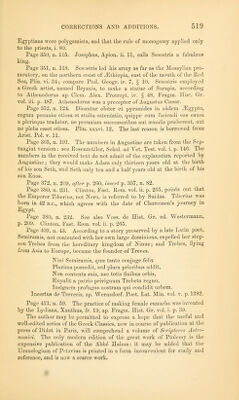
![Page 169, n. 98, after 'Plutarch,' insert, the same statement is made by Olympiodorus ad Aristot. Meteorol. vol. i. p. 198, ed. Ideler. Page 192, n. 169. Roberval, a French mathematician of the seven- teenth century, published a work under the name of Aristarchus, in which the heliocentric system was adopted. The following is its title : Aristarchi Samii de Mundi Systemate, partibus et motibus ejusdem, liber singularis. Paris. 1644. 12mo. See Biogr. Univ. art. Roberval; Delambre, Hist. Astr. Mod. vol. ii. p. 517. Page 196, n. 194. This use of the word servare, is doubtless borrowed from that of the word rr]pilv. Page 222, n. 42. An alarming eclipse of the sun, visible at Thebes, is alluded to in an extant fragment of Pindar, Hyporchem. fr. 74, ed. Bergk. It is conjectured by Ideler to be the eclipse of April 30, 465 B.C. The calamities wbich it portends (viz., war, sedition, failure of crops, ex- cessive snow, inundation, and drought) are enumerated. Page 241, n. 110. Concerning the Syromacedonian notation of months used by Josephus, see Noris, Ann. et Epoch. Syromaced. p. 44, ed. Lips. 1696. Page 252. Terra mater est in medio, quasi ovum corrotundata. Petron. Sat. c. 39. The spherical earth, fixed immovably at the centre of the spherical heaven, is described as the received opinion by Lactant. Div. Inst. iii. 24, at the beginning of the fourth century. Page 265, n. 50, Isocrat. Busir. § 24, p. 226, states that the younger portion of the Egyptian priests apply their minds to astronomy and geo- metry. Page 275, n. 114. Isocrat. Busir. § 18, p. 225, says that the Lace- daemonians borrowed several important institutions from Egypt. Page 286, n. 163. Julian, Orat. 4, says that the Chaldreans and Egyp- tians invented astronomical tables, and that Hipparchus and Ptolemy per- fected them. Page 305, n. 264. The Hermetic verses on the seven planets, ap. Stob. Phys. i. 5, 14. Anth. Pal. App. n. 40, represent Saturn as presiding over tears, Jupiter over birth, Mars over anger, Venus over appetite, Mercury over reason, the sun over laughter, and the moon over sleep. An affinity between the seven planets and certain metals was likewise dis- covered in antiquity. Lead was assigned to Saturn, electrum (a mixture of gold and silver, see above, p. 457) to Jupiter, iron to Mars, copper to Venus, tin to Mercury, gold to the sun, and silver to the moon. Olym- piodorus ad Arist. Meteor, iii. vol. ii. p. 163, ed. Ideler. Page 313, n. 301. The verses of Philemon, ap. Stob. Phys. i. 5, 11 (Meineke Fragm. Com. Gr. vol. iv. p. 6), declare that there is no general destiny, but that a destiny peculiar to each individual man is born with him. Page 318, n. 16. Desar, or Esar, a town in ^Ethiopia, founded by Egyptians, who fled from Psammitichus, is mentioned by Plin. vi. 35, compare Ptol. G-eogr. iv. 7, 21. Page 340, n. 90. Herod, ii. 92, says that monogamy was an institution common to all the Egyptians. Diodorus, on the other hand, says that the](https://iiif.wellcomecollection.org/image/b21015855_0532.jp2/full/800%2C/0/default.jpg)