Volume 1
Chemistry in space : from J. H. van 't Hoff's 'Dix années dans l'histoire d'une théorie' / translated and edited by J.E. Marsh.
- Jacobus Henricus van 't Hoff
- Date:
- 1891
Licence: Public Domain Mark
Credit: Chemistry in space : from J. H. van 't Hoff's 'Dix années dans l'histoire d'une théorie' / translated and edited by J.E. Marsh. Source: Wellcome Collection.
144/178 page 120
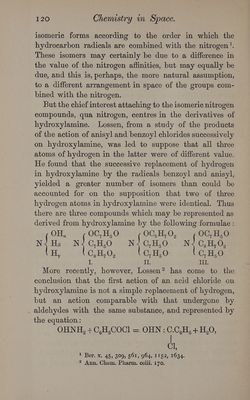
![isomeric forms according to the order in which the hydrocarbon radicals are combined with the nitrogen’. These isomers may certainly be due to a difference in the value of the nitrogen affinities, but may equally be due, and this is, perhaps, the more natural assumption, to a different arrangement in space of the groups com- bined with the nitrogen. But the chief interest attaching to the isomeric nitrogen compounds, qua nitrogen, centres in the derivatives of hydroxylamine. Lossen, from a study of the products of the action of anisyl and benzoyl! chlorides successively on hydroxylamine, was led to suppose that all three atoms of hydrogen in the latter were of different value. He found that the successive replacement of hydrogen in hydroxylamine by the radicals benzoyl and anisyl, yielded a greater number of isomers than could be accounted for on the supposition that two of three hydrogen atoms in hydroxylamine were identical. Thus there are three compounds which may be represented as derived from hydroxylamine by the following formulae : OF. OC, H,O OC, H,O, * OC, H,O0 Ny us Ny CH,0 N C10 Ny C, HO; 125 C,H,0, C,H;O C,H,;O i, II. Iii. More recently, however, Lossen? has come to the conclusion that the first action of an acid chloride on hydroxylamine is not a simple replacement of hydrogen, but an action comparable with that undergone by . aldehydes with the same substance, and represented by the equation: | OHNH, + C,H;COC] = OHN : C.C,H, + H,0, Cl, 1 Ber. x. 45, 309, 561, 964, 1152, 1634, ? Ann, Chem. Pharm. cclii. 170.](https://iiif.wellcomecollection.org/image/b33778735_0001_0144.jp2/full/800%2C/0/default.jpg)