Descriptive catalogue of the teratological series in the museum of the Royal College of Surgeons of England / [by] Benjamin Thomson Lowne.
- Benjamin Thompson Lowne
- Date:
- 1872
Licence: Public Domain Mark
Credit: Descriptive catalogue of the teratological series in the museum of the Royal College of Surgeons of England / [by] Benjamin Thomson Lowne. Source: Wellcome Collection.
Provider: This material has been provided by Royal College of Physicians, London. The original may be consulted at Royal College of Physicians, London.
30/148 (page 26)
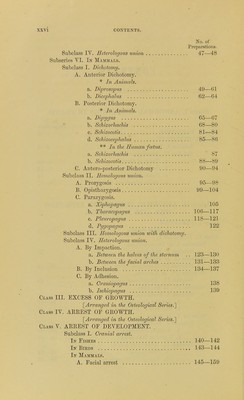
![No. of Preparations. Subclass IV. Heterologous union 47—48 Subseries VI. In Mammals. Subclass I. Dichotomy. A. Anterior Dichotomy. * In Animals. a. Diprosopus 49—01 b. Dicephalus 62—64 B. Posterior Dichotomy. * In Animals. a. Dipygus 65—67 b. Schizorhachis 68—80 c. Schizocotis 81—84 d. Schizocephalus 85—86 ** In the Human foetus. a. Schizorhachis 87 b. Schizocotis 88—89 C. Antero-posterior Dichotomy 90—94 Subclass II. Homologous union. A. Prozygosis 95—98 B. Opisthozygosis 99—104 C. Parazygosis. a. Xiphopagus 105 b. Thoracopagus 106—117 c. Pleuropagus 118—121 d. Pygopagus 122 Subclass III. Homologous union with dichotomy. Subclass IV. Heterologous union. A. By Impaction. a. Between the halves of the sternum . . 123—130 b. Between the facial arches 131—133 B. By Inclusion 134—137 C. By Adhesion. a. Craniopagus 138 b. Ischiopagus 139 Class III. EXCESS OF GROWTH. [Arranged in the Osteologiccd Series.] Class IV. ARREST OE GROWTH. [Arranged in the Osteologiccd Series.] Class V. ARREST OE DEVELOPMENT. . Subclass I. Cranial arrest. Tn Eishes 140—142 In Birds 143—144 In Mammals. A. Facial arrest 145—159](https://iiif.wellcomecollection.org/image/b24758140_0030.jp2/full/800%2C/0/default.jpg)