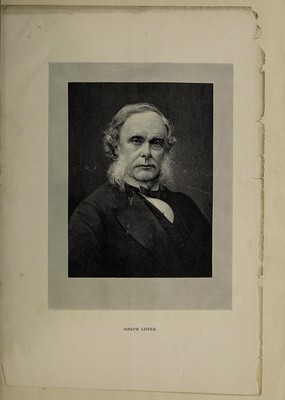
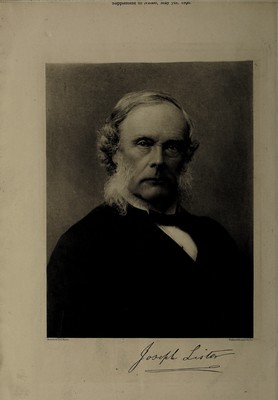
Scientific worthies : [No.] 29, Sir Joseph Lister / [Hermann Tillmanns].
- Hermann Tillmanns
- Date:
- [1896]
Licence: Public Domain Mark
Credit: Scientific worthies : [No.] 29, Sir Joseph Lister / [Hermann Tillmanns]. Source: Wellcome Collection.
16/26 (page 14)
![There can be no doubt that the Mont Mounier observa¬ tory, started under such favourable conditions, and so well supplied with instruments, will considerably assist in the advance of science. DR. ADALBERT KROGER. ' STRONOMERS in all observatories and of all nationalities will have learned with regret of the death of Dr. Kruger, the Director of the Kiel Observatory, but who, perhaps, will be more generally recalled as the editor of the Astronomische Nachrichten, and gratefully remembered for his services to that journal. From the time that Schumacher, under the auspices of the Danish Government, started the Nachrichten, no astronomical journal has proved itself so indispensable, both as a means for the publication of observations and the dis¬ semination of astronomical knowledge, or contributed more to its advance and progress. For that large class of observations of which early publication is its greatest value, but the details of which are a weariness to most editors, the Astr. Nach. has stood unrivalled, and its general conduct has wisely preserved the broad lines on which it was originally established. And with the pro¬ gress of time, as the eagerness of observers has increased with their numbers, Prof. Kruger has recognised the necessity of still more rapid means of communication, and by adding to his manifold duties that of the manage¬ ment of the Bureau central des dcpeches astronomiques, he has made still further demands on our gratitude, for the ease and certainty with which astronomical dis¬ coveries are sent all over the globe, and made available to those who take advantage of the system he has elaborated. Prof. Forster, of Berlin, we believe, early advocated the plan which has proved itself so useful, but the details of the management have been wisely left in the hands of the Director of the Kiel Observatory. But these services to science, rendered continuously from 1880, when the death of Dr. Peters made vacant both the positions which Dr. Kruger has since filled so admirably, should not put out of sight the fact that he has been both a skilled observer and an ardent astro¬ nomer. It is sufficient to recall here his more prominent services, such as the share he took with the late Dr. Schonfeld in the observation of the zones for the Durchmusterung at the Bonn Observatory : a work at first voluntarily undertaken on his part, but later in regular and active co-operation with Argelander and Schonfeld. Here, too, during an absence of Dr. Winnecke, which prevented the heliometer being used, he began and carried to a successful issue the determina¬ tion of the parallax of 70 Ophiuchi, in two very accordant series. In 1862 Dr. Kruger was appointed Director of the Helsingfors Observatory, in which the instrumental equipment was probably insufficient. There he busied himself with an inquiry into the orbit of Themis, with the view of obtaining a more accurate value of the mass of Jupiter, which the continued observation of that planet is likely to afford. The result, published in the Proceedings of the Finnish Society of Sciences, was to show that Bessel’s value of the mass of Jupiter, the then received value, required to be increased by the 68/100,000 part, and to give a value intermediate between that of Airy and Bessel, as derived from the motions of the satellites. From Helsingfors, Dr. Kruger went to the Observatory at Gotha, where he stayed five years, leaving that city to take up his final position at the well-equipped Kiel Observatory, m 1880. For after the termination of the Danish dominion in the Elbe Duchies, the observatory had been enriched by the instruments from the old observatory at Altona, and had been brought into closer relations with the university. This position naturally NO. 1384, VOL. 54] carried with it the editorship of the Nachrichten, to which allusion has already been made. It is true that since the journal has been under his care, the words “ Unter Mit- wirkung des Vorstandes der Astronomischen Gesellschaft ” have appeared on the title-page, but we imagine Dr. Kruger has enjoyed a free hand in its management, with beneficial results to the journal and to his own reputation. In his capacity as Director, he has published many obser¬ vations of comets, and prepared, or had prepared under his own eye, the orbits and ephemerides of many of these bodies. These computations have been occasionally enriched by notices of a mathematical character, such as the effect of perturbations by planets near the sun. He has also occasionally given original observations of stars observed with comets, and in many useful, if not brilliant, ways, he has shown his capacity as a Director of an observatory. His career has been marked by an energy and industry, to which might be applied the words of Schiller, “ Beschaftigung die nie ermattet, die langsam wirkt doch nie zerstort.” NOTES. The first of the two annual conversaziones of the Royal Society was held last night, as we went to press. The Council of the British Association have resolved to nominate Sir John Evans, K.C.B., Treasurer of the Royal Society, for the presidency at the meeting whieh will be held next year in Toronto. The following fifteen candidates were selected on Thursday last by the Council of the Royal Society, to be recommended for election into the Society :—Sir G. S. Clarke, Dr. J. N. Collie, Dr. A. M. W. Downing, Dr. F. Elgar, Prof. A. Gray, Dr. G. J. Hinde, Prof. II. A. Miers, Dr. F. W. Mott, Dr. J. Murray, Prof. K. Pearson, Rev. T. R. R. Stebbing, Prof. C. Stewart, Mr. W. E. Wilson, Mr. H. B. Woodward, Dr. W. P. Wynne. The qualifications of the candidates will be found in another part of this issue. The Surinam Toads (Pipa americana), at the Zoological Society’s Gardens, have recommenced breeding this year, and two of the females may now be seen with their backs covered with cells, in each of which an egg is located. The hitherto un¬ explained mode in which the eggs are transferred into their cells has been discovered, and the secret was divulged at the last scientific meeting of the Society. An unnamed donor has given Harvard University 100,000 dols. to found a Chair of Comparative Pathology, the only one of the kind in any leading American University. The generous hospitality always dispensed to British men of science by continental Governments beggars anything ever done officially in England to welcome foreign visitors dis¬ tinguished in science. We have already notified that the summer meetings of the Institution of Naval Architects will be held this year in Hamburg on Monday, June 8, and the follow¬ ing day. On Wednesday, June 10, the meetings ill be trans¬ ferred to Berlin, on the invitation of the Imp rial Germa Government, and will be continued there during he remainder of the week. With a public spirit which should put British steamboat companies to shame, the Hamburg-American Com¬ pany have generously offered to take the members over in a body from Tilbury to Hamburg in their twin-screw Transatlantic liner the Burst Bismarck free of charge. The steamer will start either late on Saturday night, June 6, or else early on Sunday morning, June 7, and will arrive in Hamburg in about twenty hours after its departure. The meetings are receiving the warmest support from the Imperial Government, and the arrangements in Berlin are being carried out by the Imperial](https://iiif.wellcomecollection.org/image/b30592069_0016.jp2/full/800%2C/0/default.jpg)