Report of the Medical Services, Ministry of Health, Sudan Government.
- Sudan. Wizārat al-Ṣiḥḥah. Medical Services.
- Date:
- [1961]
Licence: Public Domain Mark
Credit: Report of the Medical Services, Ministry of Health, Sudan Government. Source: Wellcome Collection.
64/100 page 60
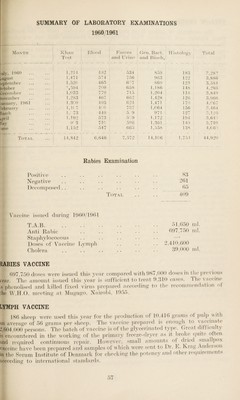
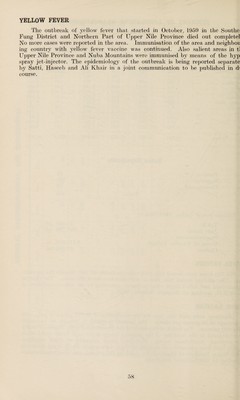
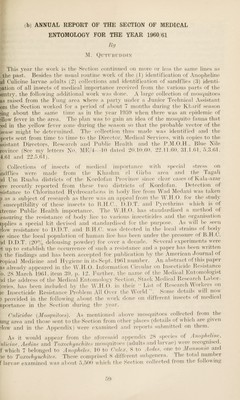
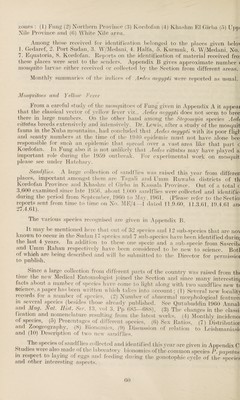
![Nile Province and (0) White Nile area. Among those received for identification belonged to the places given belo^ 1. Geclaref, 2. Port Sudan, 3. W/Medani, 4. Haifa, 5. Kurmuk, 6. W/Medani, No. 7. Equatoria, 8. Kordofan. Reports on the identification of material received fro these places were sent to the senders. Appendix B gives approximate number < mosquito larvae either received or collected by the Section from different areas. Monthly summaries of the indices of Aedes aegypti were reported as usual. Mosquitoes and Yellow Fever From a careful study of the mosquitoes of Fung given in Appendix A it appeal that the classical vector of yellow fever viz., Aedes aegypti does not seem to bree there in large numbers. On the other hand among the Stegomyia species Aedi vittatus breeds extensively and intensively. Dr. Lewis, after a study of the mosquit fauna in the Nuba mountains, had concluded that Aedes aegypti with its poor fligf and scanty numbers at the time of the 1940 epidemic must not have alone bee responsible for such an epidemic that spread over a vast area like that part c Kordofan. In Fung also it is not unlikely that Aedes vittatus may have played a important role during the 1959 outbreak. For experimental work on mosquit please see under Hatchary. Sandflies. A large collection of sandflies was raised this year from differed places, important amongst them are Tagali and Umm Ruwaba districts of th Kordofan Province and Khashm el Girba in Kassala Province. Out of a total c 3,600 examined since late 1956, about 1,000 sandflies were collected and identifier during the period from September, I960 to May, 1961. (Please refer to theSectio reports sent from time to time on No. ME/4—i dated 11.9.60, 11.3 61 19 4 61 am 27.4.61). The various species recognised are given in Appendix B. It may be mentioned here that out of 32 species and 12 sub-species that are nor known to occur in the Sudan 17 species and 7 sub-species have been identified dump the last 4 years. In addition to these one specie and a sub-specie from Sasreibi and Umm Rahau respectively have been considered to be new to science. Botl of which are being described and will be submitted to the Director for permissioi to publish. Since a large collection from different parts of the country was raised from th time the new Medical Entomologist joined the Section and since many interestin facts about a number of species have come to light along with two sandflies new t science, a paper has been written which takes into account; (1) Several new localit records for a number of species, (2) Number of abnormal morphological feature m several species (besides those already published. See Qutubuddin 1960 Anna] and Mag. hat. Hist. Ser. 13, vol 3, Pp 685—688), (3) The changes in the class: fication and nomenclature resulting from the latest works, (4) Monthly incidenc of species, (5) Percentages of different species, (6) Sex Ratios, (7) Distribute: and Zoogeography, (8) Bionomics, (9) Discussion of relation to Leishmaniasi and (10) Description of two new sandflies. ^ The species of sand) lies collected and identified this year are given in Appendix C St udies were also made of the laboratory bionomics of the common species P. papatas in respect to laying of eggs and feeding during the gonotophic cvcle of the specie and other interesting aspects. 60](https://iiif.wellcomecollection.org/image/b31494559_0064.jp2/full/800%2C/0/default.jpg)