Report on the mortality of cholera in England, 1848-49.
- General Register Office Northern Ireland
- Date:
- 1852
Licence: Public Domain Mark
Credit: Report on the mortality of cholera in England, 1848-49. Source: Wellcome Collection.
Provider: This material has been provided by King’s College London. The original may be consulted at King’s College London.
98/510
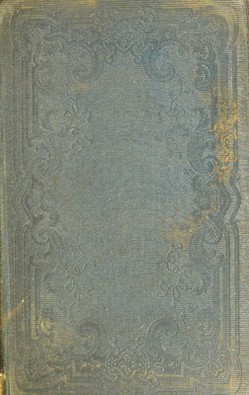
![While the facts prove that the population was undergoing a morbid change, which may have issued in a great epidemic, it seems more consonant with the whole history of the disease to admit that while the materials were smouldering in England the flame which threw the mass into combustion was of Asiatic origin. It is not necessary to discuss the zymotic theory here, but I give in a note the substance of a paper on the subject which appeared in the Appendix to the Registrar-General’s Fourth Report. As there restricted, it only expresses certain facts in the history of diseases, and of cholera among the rest, which are shown to be analogous to other facts with which chemistry is conversant. It may, I think, be admitted that the disease Asiatic cholera is induced in man by a certain specific matter, and as it has been proposed to call the matter varioline which causes small-pox, so cholerine may designate the zymotic principle of cholera. A variety of that matter was produced in India in certain unfavourable circumstances ; it had the property of propagating and multiplying itself in air, or water, or food, and of destroying men, by producing in successive attacks the series of phenomena which con- stitute Asiatic cholera. That cholerine is an organic matter, cannot, I think, be doubted by those avho have studied the whole of its phenomena and the general laws of zymotic disease. The great questions remain—Is cholerine produced in the human organization alone and propagated by excreted matter? Is it produced and propagated in dead animal or vege- table matter or mixed infusions of excreta and other matter out of the body ? Is it propagated through water? through air? through contact? or through all these channels? Observations sufficiently exact to decide these questions definitively have yet to be made, and discussed on the principles of probability. The decisive facts cannot be investigated by experiments in which human life may be exposed to risk. They must be carefully looked for and noted by good observers. Conflicting theories serve, among other purposes, to direct the attention of observers to important points which they may otherwise neglect. While fully admitting the importance of theories, I have endeavoured to present, from the Returns, a view of the facts, without reference to any theory; and to show, inde- pendently of the theories, that the conditions in which cholera is or is not fatal, may be determined, and yield important practical deductions. Note.—The zymotic hypothesis, which is strictly applicable to all the known phenomena of cholera, is thus stated in the Appendix to the Fourth Annual Report, 8vo, of the Registrar-General, pp. 199—105. “ Miasm, properly so called, causes disease without being itself reproduced. * * * Carbonic acid and sulphuretted hydrogen, which are frequently evolved from the earth in cellars, mines, wells, sewers, and other places, are amongst the most pernicious miasms,’’ (Liebiy). Miasms produce diseases like ague, without being propagated by contagion ; and the poisons—carbonic acid, sulphuretted hydrogen, and other gases, which are given off by organic matter in putrefaction, afford an illustration of their action. The miasm which excites intermittent fever may be designated pyretine; and if it were not probable that modifications of the marsh miasm induce, in certain circumstances, remittent and yellow fever, specific names should be found for their principles. Rheumatic fever is apparently caused by a miasm.* Its changes of scat can scarcely be accounted for on the hypothesis that it is a local inflamma- tion of the fibrous tissue. Certain matters which have not yet been analyzed produce small-pox, glanders, hydrophobia, syphilis, measles, scarlatina, and other diseases ; and as it was before proposed to give names to the well-defined diseases produced by poisons, so, for the purposes of reasoning, it will be equally useful to name these specific matters or transformations of matter by which diseases are propagated either by inoculation and contact (contagion), or by inhalation (infection). The following list exhibits the popular and scientific names of diseases in juxtaposition with the pioposed names of their exciters ; and it may be assumed hypothetically, that in the blood corresponding bodies exist which are destroyed, and by the transformation of which the exciters are generated or reproduced. The names in the second column terminate in a, except a few in s. Lyssa (from \ueea., rabies), the old Greek term, has been lestored by Mason Good; I propose, for the sake of uniformity, to call puerperal fever mctria ; mumps, parotid, reserving parotitis for simple inflam- mation of the parotids; croup, truclteia ; and the disease from puncture in dissection, necusia («*»;, the dead body). • The exciting cause of intermittent fevers, rheumatism, anil [rheumatic] neumljjia, is generally admitted (?1 to be malaria; and if viewed abstractedly, and with reference to their spccillc nature, it it probable that malaria it the on/y 1 rcitiny cause of these diseases.—I’rout on Stomach and Urinary Diseases, p. SO.](https://iiif.wellcomecollection.org/image/b21308251_0098.jp2/full/800%2C/0/default.jpg)