Statistics of the Royal Infirmary of Glasgow. Third series : compiled from the records of the institution for 1846 / by R.S. Orr.
- Date:
- [1847?]
Licence: Public Domain Mark
Credit: Statistics of the Royal Infirmary of Glasgow. Third series : compiled from the records of the institution for 1846 / by R.S. Orr. Source: Wellcome Collection.
Provider: This material has been provided by the Royal College of Physicians of Edinburgh. The original may be consulted at the Royal College of Physicians of Edinburgh.
31/38 (page 29)
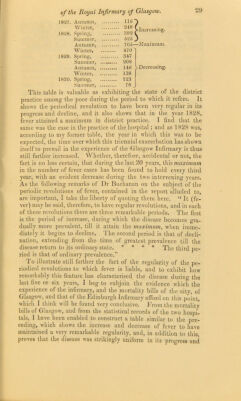
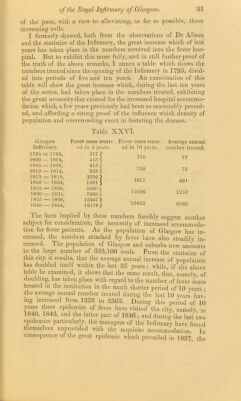
![1827. Autumn, 116' Winter, 218 1828. Spring 392 -Increasing. 1829. 1830. Summer, .. 525 Autumn, .. 705' Winter, 470 Spring, .. 347 Summer, . Autumn, . . 146 Winter, . 138 Spring, . 123 Summer, . 78 >. Decreasing. This table is valuable as exhibiting the state of the district practice among the poor during the period to which it refers. It shows the periodical revolution to have been very regular in its progress and decline, and it also shows that in the year 1828, fever attained a maximum in district practice. I find that the same was the case in the practice of the hospital; and as 1828 was, according to my former table, the year in which this was to be expected, the time over which this triennial exacerbation has shown itself to prevail in the experience of the Glasgow Infirmary is thus still farther increased. Whether, therefore, accidental or not, the fact is no less certain, that during the last 20 years, this maximum in the number of fever cases has been found to hold every third year, with an evident decrease during the two intervening years. As the following remarks of Dr Buchanan on the subject of the periodic revolutions of fever, contained in the report alluded to, are important, I take the liberty of quoting them here. “ It (fe- ver) may be said, therefore, to have regular revolutions, and in each of these revolutions there are three remarkable periods. The first is the period of increase, during which the disease becomes gra- dually more prevalent, till it attain the maximum, when imme- diately it begins to decline. The second period is that of decli- nation, extending from the time of greatest prevalence till the disease return to its ordinary state. * * * * T]ie third pe- riod is that of ordinary prevalence.” To illustrate still farther the fact of the regularity of the pe- riodical revolutions to which fever is liable, and to exhibit how remarkably this feature has characterised the disease during the last five or six years, I beg to subjoin the evidence which the experience of the infirmary, and the mortality bills of the city, of Glasgow, and that of the Edinburgh Infirmary afford on this point, which I think will be found very conclusive/ From the mortality bills of Glasgow, and from the statistical records of the two hospi- tals, I have been enabled to construct a table similar to the pre- ceding, which shows the increase and decrease of fever to have maintained a very remarkable regularity, and, in addition to this, proves that the disease was strikingly uniform in its progress and](https://iiif.wellcomecollection.org/image/b21977513_0033.jp2/full/800%2C/0/default.jpg)