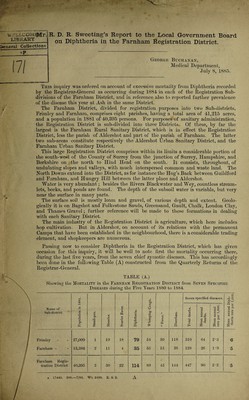
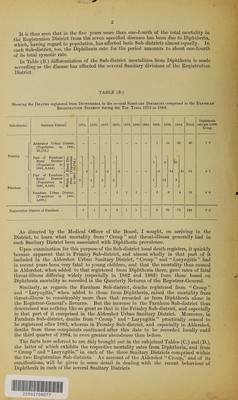
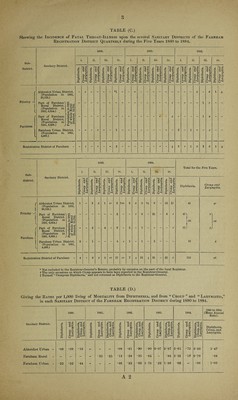
Mr. R.D.R. Sweeting's report to the Local Government Board on diphtheria in the Farnham registration district / [R.D.R. Sweeting].
- Sweeting, R. Deane.
- Date:
- [1885]
Licence: Public Domain Mark
Credit: Mr. R.D.R. Sweeting's report to the Local Government Board on diphtheria in the Farnham registration district / [R.D.R. Sweeting]. Source: Wellcome Collection.
4/20 page 4
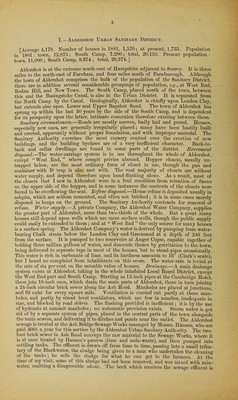
![I. — Aldershot Urban Sanitary District. [Acreage 4,178. Number of bouses in 1881, 1,570; at present, 1,735. Population in 1881: town, 12,875; South Camp, 7,280; total, 20,155. Present population: town, 11,000 ; South Camp, 9,374 ; total, 20,374.] Aldershot is at the extreme north-east of Hampshire adjacent to Surrey. It is three miles to the north-east of Earnham, and four miles south of Earnborough. Although the town of Aldershot comprises the bulk of the population of the Sanitary District, there are in addition several considerable groupings of population, e.g., at West End, Redan Hill, and New Town. The South Camp, placed north of the town, between this and the Basingstoke Canal, is also in the Urban District. It is separated from the North Camp by the Canal. Geologically, Aldershot is chiefly upon London Clay, but extends also upon Lower and Upper Bagshot Sand. The town of Aldershot has sprung up within the last 30 years by the side of the South Camp, and is dependent for its prosperity upon the latter, intimate connexion therefore existing between them. Sanitary circumstances.—Roads are mostly uneven, badly laid and paved. Houses, especially new ones, are generally irregularly placed; many have been hastily built and erected, apparently without proper foundation, and with improper material. The Sanitary Authority exercises the most cursory control over the erection of new buildings, and the building byelaws are of a very inefficient character. Back-to- back and cellar dwellings are found in some parts of the district. Excrement disposal.—The water-carriage system is in use throughout the whole of Aldershot, except “West End,” where cesspit privies abound. Hopper closets, usually un¬ trapped below, are the most ordinary form of closet in use, though the pan and container with D trap is also met with. The vast majority of closets are without water supply, and depend therefore upon hand-flushing alone. As a result, most of the closets that I saw in Aldershot were in a foul condition from retention of fgeces on the upper side of the hopper, and in some instances the contents of the closets were found to he overflowing the seat. Refuse disposal.—House refuse is deposited usually in ashpits, which are seldom cemented, and often not bricked; it is in some cases merely disposed in heaps on the ground. The Sanitary Authority contracts for removal of refuse. Water supply.—A private Company, the Aldershot Water Company, supplies the greater part of Aldershot, more than two-thirds of the whole. But a great many houses still depend upon wells which are mere surface wells, though the public supply could easily be extended to them; and at “ West End ” the only source for many houses is a surface spring. The Aldershot Company’s water is derived by pumping from water¬ bearing Chalk strata below the London Clay and Greensand at a depth of 240 feet from the surface. It is pumped to two reservoirs at Anger Copse, capable together of holding three million gallons of water, and descends thence by gravitation to the town, being delivered to separate taps in most of the houses, but to stand-pipes occasionally. This water is rich in carbonate of lime, and its hardness amounts to 16° (Clark’s scale), but I heard no complaint from inhabitants on this score. The water-rate is levied at the rate of six percent, on the rateable value of houses. Drainage.—A main drainage system exists at Aldershot, taking in the whole inhabited Local Board District, except the West End part and South Camp. Starting as 12-inch pipes at the Cambridge Hotel, these join 18-incli ones, which drain the main parts of Aldershot, these in turn joining a 24-inch circular brick sewer along the Ash Road. Manholes are placed at junctions, and 63 exist for every square mile. Ventilation is carried out partly at these man¬ holes, and partly by street level ventilators, which are few in number, inadequate in size, and blocked by road debris. The flushing provided is inefficient; it is by the use of hydrants at summit manholes ; no automatic provision exists. Storm water is got rid of by a separate system of pipes, placed in the central parts of the town alongside the main sewers, and delivering it to ditches and ponds near the outlet. The Aldershot sewage is treated at the Ash Bridge Sewage Works managed by Messrs. Hanson, who are paid 40(E. a year for this service by the Aldershot Urban Sanitary Authority. The two- foot brick sewer in Ash Road conveys the raw material to the Sewage Works, where it is at once treated by Hanson’s process (lime and soda-waste), and then pumped into settling tanks. The effluent is drawn off from time to time, passing into a small tribu¬ tary of the Blackwater, the sludge being given to a man who undertakes the cleaning of the tanks ; he sells tlm sludge for what he can get to the farmers. At the time of my visit, some of this sludge had not been removed, and was mixed with rain¬ water, emitting a disagreeable odour. The beck which receives the sewage effluent is](https://iiif.wellcomecollection.org/image/b30557410_0004.jp2/full/800%2C/0/default.jpg)