The principles of physiology applied to the preservation of health, and to the improvement of physical and mental education / by Andrew Combe.
- Date:
- 1852
Licence: Public Domain Mark
Credit: The principles of physiology applied to the preservation of health, and to the improvement of physical and mental education / by Andrew Combe. Source: Wellcome Collection.
Provider: This material has been provided by the Royal College of Physicians of Edinburgh. The original may be consulted at the Royal College of Physicians of Edinburgh.
244/376 page 220
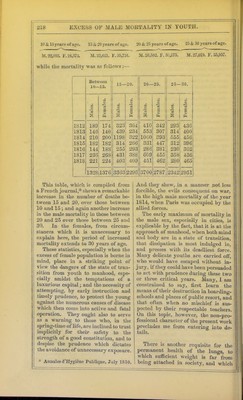
![early married of both sexes is the cor- rect inference from the fact referred to. During growth and for a consi- derable time afterwards, the constitu- tion is still imperfect even in healthy subjects, and wants the enduring strength wliich it acquires in mature age, and the possession of which marks the period which Nature has fixed for the exercise of the functions of reproduction. Many young people of both sexes fall sacrifices to early marriage, who might have withstood the ordinary risks of life, and lived together in happiness, if thej' had de- layed their union for a few years, and allowed time for the consolidation of their constitutions. These remarks are confirmed bj' the returns of the French army, which shew that the young recruits, who join at 20, are much less able to withstand injurious influences than older soldiers whose systemshave becomeconsolidated. Dui'- ing the first years of service the mor- , tality amounts to 7^ per cent., during the second to 6| per cent., and gra- dually decreases to 2 ])er cent, during the sixth and seventh years.* I have urged this point strongly, because hereditary predisposition is, avowedly and beyond all doubt, a fre- quent source of the more serious forms of pulmonary disease, and it would be worse than folly to allowpast and pain- ful experience to go for nothing. Medi- cal men have much in their power in preventing such violations of the laws of the Creator, at least where thej' are regarded, as they should always be, as the friends not less than the pro- fessional advisers of the family. An instructive example of the influence of the mother on the health of progeny is afforded by the relative mortality of Jewish and Christian infants in Prussia. Jewesses there seldom work in factories, and least of all when pregnant, or having the care of very young children. This custom gives the Jewish pojiulation such an advan- tage in point of health, that where- as in every 100,000 Christians born, * Annnlcs d'Hygicne Publitiue, April 181D, p. 292. there are 3569 still-born, there are only 2524 in the same number of the Jews; whUe out of 100,000 infants of Christian parentage, 17,413 die in the first year, but only 12,935 in 100,000 of the Jewish race.f In connection with this subject, I may mention that Sir James Clark has the merit of having drawn attention to the impoi'tant fact, that a state of impaired health in the parent, whether constitutional or acquired, and particu- larly if caused by imperfect digestion and assimilation, is as productive of a tendency to scrofula and consumption in the children as if it had descended by hereditary transmission. If pa- rents in general were duly impressed with the truth and bearing of this fact, many of them might be induced, on account of their children, to take that rational care of their own health which they seem to be incapable of doing for their own sake. The last requisite for the health of the lungs which I need mention here is a due supply of rich and healthy blood. When, from defective food, or impaired digestion, the blood is im- poverished in quality, and rendered unfit for adequate nutrition, the lungs speedily suffer, and that often to a fatal extent. So certain is this fact, that, in the lower animals, tubercles (the cause of incurable consumption) can be produced in the lungs to almost any extent, by ivithholdinff a sufficiency of nourishing food, and by causing them to breathe a vitiated atmosphere. The same circumstances operate to a la- mentable extent among the poorly fed pojiulation of our manufacturing towns ; whereas it is proverbial that butchers—a class of men who eat ani- mal food twice or thrice a day, and live much in the open air—are almost exempt from pulmonary consumption. Among the higher classes, again, the blood is impoverished, and the lungs are injured, not from want of food, but from want of the power of ade- quately digesting it; and hence we t Annnles d'llygiene Publique, July ! 1S50, p. 23.](https://iiif.wellcomecollection.org/image/b21965353_0244.jp2/full/800%2C/0/default.jpg)



 No text description is available for this image
 No text description is available for this image
 No text description is available for this image