The principles of physiology applied to the preservation of health, and to the improvement of physical and mental education / by Andrew Combe.
- Date:
- 1852
Licence: Public Domain Mark
Credit: The principles of physiology applied to the preservation of health, and to the improvement of physical and mental education / by Andrew Combe. Source: Wellcome Collection.
Provider: This material has been provided by the Royal College of Physicians of Edinburgh. The original may be consulted at the Royal College of Physicians of Edinburgh.
353/376 page 329
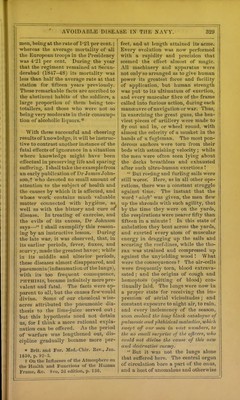
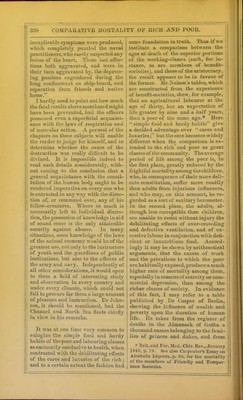
![men, being at the rate of 1'21 per cent.; whereas the average mortality of all the Eurojiean troops in the Presidency was 4:-21 per cent. Diirini; the year that the regiment remained at Secun- derabad (18-1:7-48) its mortality was less than half the average rate at that station for fifteen years previously. These remarkable facts arc ascribed to the abstinent habits of the soldiers, a large proportion of them being tee- totallers, and those who were not so being very moderate in their consump- tion of alcoholic liquors.* With these successful and cheering results of knowledge, it will be instruc- tive to contrast anotlier instance of the fatal effects of ignorance in a situation where knowledge might have been effectual in preserving life and sparing suffering. I shall take the examplefi-ora an early publication of Dr James John- son,! who devoted no small amount of attention to the subject of health and the causes by which it is affected, and whoee work contains much valuable matter connected with hygiene, as well as with the history and cure or disease. In treating of exercise, and the evils of its excess, Dr Johnson says— I shall exemplify this reason- I ing by an instructive lesson. During i the late war, it was observed, that, in I its earlier periods, fever, fluxes, and scurvy, made the greatest havoc; while in its middle and ulterior periods, these diseases almost disappeared, and pneumoniaf inllammation of the lungs), with its too frequent consequence, PHTHISIS, became infinitely more pre- valent and fatal. Tiie facts were ap- parent to all, but the causes fowcould divine. Some of our chemical wise- acres attributed the pneumonic dia- thesis to the lime-juice served out; but this hypothesis need not detain us, for I think a more rational expla- nation can be offered. As the period of warfare was lengthened out, dis- cipline gradually became more per- • Brit, and For. Med.-Cliir. Rev., Jan. 1850, p. 02-3. f On the InHuencc of the Atmosphere on the Health and Functions of the Human Frame, &c. 8vo, '2d edition, p. 130. feet, and at length attained its acme. Every evolution was now performed with a rapidity and 2)recision that seemed the effect almost of magic. All machinery and apparatus were not only so arranged as to give human power its greatest force and facility of application, but human strength was put to its ultimatum of exertion, and every muscular fibre of the frame called into furious action, during each manoeuvre of navigation or war. Thus, in exercising the great guns, the hea- viest jjieces of artillery were made to fly out and in, or wheel round, with almost the celerity of a musket in the hands of a fugleman. The most pon- derous anchors were torn from their beds with astonishing velocity ; while the men were often seen lying about the decks breathless and exhausted after such ultra-human exertions ! ]]ut reefing and furling sails were still worse. Here, as in all other ope- rations, there was a constant struggle against time. The instant that the word 'aloft' was given, the men flew up the shrouds with such agility, that by the time they were on tlie yards, the respirations were nearer fifty than fifteen in a minute ! In this state of anhelation they bent across the yards, and exerted every atom of muscular energy in dragging up the sails and securing the reef-lines, while the tho- rax was strained and compressed up against the unyielding wood ! What were the consequences ? The air-cells were frequently torn, blood oxtrava- sated; and the origins of cough and hemoptoes (spitting of blood) con- tinually laid. The lungs were now in a proper state for receiving the im- j^ression of aerial vicissitudes; and constant exposure to night air, to rain, and every inclemency of the season, soon evolved the lonr/ black catalogue of pulmonic and phthisical maladies, which swept off our men in vast numbers, to the no small surprise of the officers, who could not divine the cause of this new and destructive enemy. But it was not the lungs alone that suff'ered here. The central organ of circulation bore a part of the onus, and a host of anomalous and otherwise](https://iiif.wellcomecollection.org/image/b21965353_0353.jp2/full/800%2C/0/default.jpg)
 No text description is available for this image
 No text description is available for this image
 No text description is available for this image