The principles of physiology applied to the preservation of health, and to the improvement of physical and mental education / by Andrew Combe.
- Date:
- 1852
Licence: Public Domain Mark
Credit: The principles of physiology applied to the preservation of health, and to the improvement of physical and mental education / by Andrew Combe. Source: Wellcome Collection.
Provider: This material has been provided by the Royal College of Physicians of Edinburgh. The original may be consulted at the Royal College of Physicians of Edinburgh.
355/376 page 331
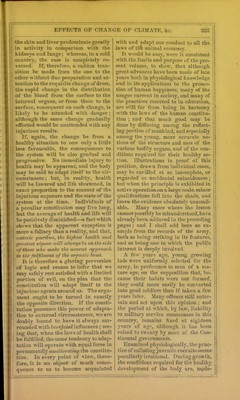
![the official returns of the population of Berlin a tliousand names of persons who had lived upon charity, and whose deaths had been carefully registered. Of a thousand ricli and poor there were existing, ^ays he— KUli. I'oor. At the age of 5 years, 043 655 10 ... 938 598 15 ... Oil 584 20 ... 886 66(> 25 ... sr,-2 553 30 ... 79l! 527 35 ... 753 486 40 ... 693 446 45 ... 624 396 50 ... 557 33S 55 ... 464 283 60 ... 393 226 65 ... 318 172 70 ... 235 117 75 ... 139 65 80 ... 57 21 85 ... 29 9 ... 90 ... 25 4 95 ... 1 2 100 ... 0 0 In strict accordance with these facts, it appears, from the returns, that t!ie mortality among the children of the poorer classes in Paris is nearly double that occurring among those in more affluent circumstances ; wliile, in the wealthier departments of France, the average of life is twelve years greater than in those which are poor. Similar results are observed in J^ondon, where, according to l)r Granvilles tables, only 5i2 infants out of every 1000 births among the jjoor survive their second year; and both in Paris and in London, the mortality in the quarters inhabited by the worlving-classes, is proved to be nearly doulde tliat which occurs in those inhabited by the more wealthy. The influence of impover- ished diet, defective clothing, and un- favourable moral position, is further strikingly exhibited among the chil- dren of soldiers, of whom, according to Marshall, only a very small propor- tion reach the age of manhood ; most scrofulous in constitution, and bad in morals.* If such, then, be the disproportion which occurs between the rates of mortality in tlie difftn-eut classes of society in Great Britain, it suggests some most important considerations, the first of which is the simple ques- tion, Whether that condition of the lower orders can be regarded as emi- nently prosperous or natural, which subjects thenj to be cut off by death so many years before the term allotted to those by whom they arc employed ? It also illustrates, strikingly, w'hat I have said about bad health being more frequently the result of gradual causes long in unperceived operation, than of any sudden or accidental exposure; and proves that a mode of life or de- gree of labour is not to be rashly pro- nounced harmless, merely because its injui'ious effects are not immediately seen, and because years may elapse before it breaks down the constitution. It is blindness to tlie existence of this principle w^hich still misleads man- kind, and renders them insensible to the agency of numerous hurtful influ- ences, from which, by a little exertion, tliey might easily be relieved. Still it is cheering to observe that, on the whole, the condition of society is steadily improving. We have al- ready mentioned the general decrease of the mortality of London, and may here shortly notice the result of the late researches of M. Ch. Dupin on the longevity of the inhabitants of France. From tliese it appears that the present average duration of life amonff all the classes of the French ])opulation, is higher than it was in the first half of last century among picked lives taken from the ranks of individuals of independent means.f In these simple facts is chronicled a vast advance in social progress ; but still it cannot bo denied, that in indi- vidual cities and individual districts of cities, the public health lias of late years rather deteriorated than im- j proved. Thus we have seen that the ! * Marshall on FnlLstiii?, Sec, p. 16. | t AnnaU's d'Hygiene Publique, April i](https://iiif.wellcomecollection.org/image/b21965353_0355.jp2/full/800%2C/0/default.jpg)

 No text description is available for this image
 No text description is available for this image
 No text description is available for this image