Penotus palimbios: or The alchymists enchiridion. : In two parts. The first containing excellent experienced chymical receipts and balsoms for healing and curing most diseases incident to the body of man, &c. The second part, containing the Practica mirabilis for the accomplishing and obtaining from the beginning to the end the white and red elixir, which whosoever understands, need not read any other book. As also several chymical axioms. Together with a small treatise by way of dialogue, written by that very ancient philosopher Arislaus, concerning the philosophers stone. To which second part is prefix'd an apologetick introduction, written in answer to a scurrilous libel, published in Latin in Germany by D. Nicholaus Guibertus, in which answer is maintain'd both by reason and authority against the said libel, the possibility of making an elixir for transmutation of lead, and all other imperfect mettals into pure gold and silver. The whole written in Latin long since by that famous Helvetian Bernardus Penotus a Portu Sanctæ Mariæ Aquitani, and now faithfully Englished and claused by B. P. Philalethes.
- Bernard Gilles Penot
- Date:
- 1692
Licence: Public Domain Mark
Credit: Penotus palimbios: or The alchymists enchiridion. : In two parts. The first containing excellent experienced chymical receipts and balsoms for healing and curing most diseases incident to the body of man, &c. The second part, containing the Practica mirabilis for the accomplishing and obtaining from the beginning to the end the white and red elixir, which whosoever understands, need not read any other book. As also several chymical axioms. Together with a small treatise by way of dialogue, written by that very ancient philosopher Arislaus, concerning the philosophers stone. To which second part is prefix'd an apologetick introduction, written in answer to a scurrilous libel, published in Latin in Germany by D. Nicholaus Guibertus, in which answer is maintain'd both by reason and authority against the said libel, the possibility of making an elixir for transmutation of lead, and all other imperfect mettals into pure gold and silver. The whole written in Latin long since by that famous Helvetian Bernardus Penotus a Portu Sanctæ Mariæ Aquitani, and now faithfully Englished and claused by B. P. Philalethes. Source: Wellcome Collection.
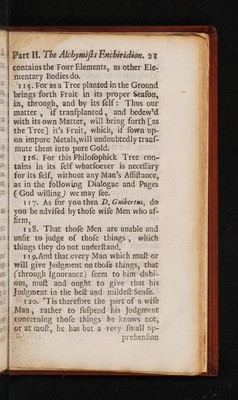
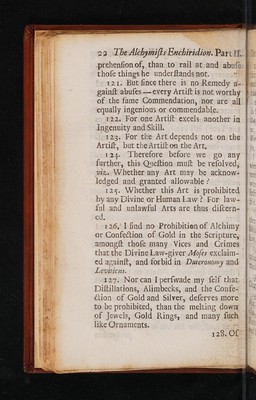
![prehenfion of, than to rail at and abufé:} thofe things he underftands not. | 121. But fince there is no Remedy a-.] gainft abufes — every Artift is not worthy | | of the fame Commendation, nor are all | equally ingenious or commendable. 122. For one Artift excels, another in Ingenuity and Skill. | 123. For the Art depends not on the | jj, Artift, but the Artift on the Art, |; 124. Therefore before we go any | i further, this Queftion mult be refolved, |. viz. Whether any Art may be acknow- |y. ledged. and granted allowable ? 12s. Whether this Art is prohibited by any Divine or Human Law ? For law- ful and unlawful Arts are thus difcern- ed. ( 126, I find no Prohibitienof Alchimy |i. or Confection of Gold in the Scripture, amongít thofe many Vices and Crimes that the Divine Law-giver 7Mofes exclaim- || ,. ed againft, and forbid in Duteronomy and |... Leviticus. 127. Norcan I perfwade my felf that, }, Duttillations, Alimbecks, and the Confe- ction of Gold and Silver, deferves more i to be prohibited, than the melting down Er. of Jewels, Gold Rings, and many fuch like Ornaments. MÀ Km gessi sm aet 128. Of](https://iiif.wellcomecollection.org/image/b30338207_0066.jp2/full/800%2C/0/default.jpg)