Licence: Public Domain Mark
Credit: What is homoepathy? / [by John Epps]. Source: Wellcome Collection.
Provider: This material has been provided by The University of Glasgow Library. The original may be consulted at The University of Glasgow Library.
5/16 (page 5)
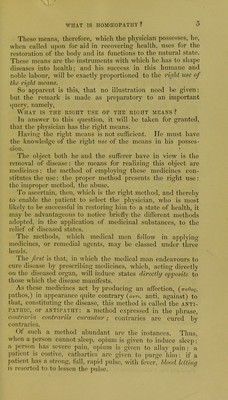
![These means, therefore, whieh the physician possesses, he, when called upon for aid in recovering health, uses for the restoration of the body and its functions to the natural state. These means are the instruments with which he has to shape diseases into health; and his success in this humane and noble labour, will be exactly proportioned to the right use of the t'ight means. So apparent is this, that no illustration need be given: but the remark is made as preparatory to an important query, namely. What is the right use of the right means ? In answer to this question, it will be taken for granted, that the physician has the right means. Having the right means is not sufficient. He must have the knowledge of the right use of the means in his posses- sion. • The object both he and the sufferer have in view is the removal of disease: the means for realizing this object are medicines: the method of emjiloying these medicines con- stitutes the use: the proper method presents the right use: the improper method, the abuse. To ascertain, then, which is the right method, and thereby to enable the patient to select the physician, who is most likely to be successful in restoring him to a state of health, it may be advantageous to notice briefly the different methods adopted, in the application of medicinal substances, to the relief of diseased states. The methods, which medical men follow in applying medicines, or remedial agents, may be classed under three heads. The first is that, in which the medical man endeavours to cure disease by prescribing medicines, which, acting directly on the diseased organ, will induce states directly opposite to those which the disease manifests. As these medicines act by producing an affection, ( iraQoQ, pathos,) in appearance quite contrary {avn, anti, against) to that, constituting the disease, this method is called the anti- pathic, or ANTIPATHY: a method expressed in the phrase, eontraria contrariis curantur; contraries are cured by contraries. Of such a method abundant are the instances. Thus, when a person cannot sleep, opium is given to induce sleep: a person has .severe pain, opium is given to allay pain: a ])atient is costive, cathartics arc given to purge him: if a patient has a strong, full, rapid jndse, with fever, hlood letting is resorted to to lessen the pulse.](https://iiif.wellcomecollection.org/image/b24921580_0007.jp2/full/800%2C/0/default.jpg)