Dr. Reginald Farrar's report to the Local Government Board on the sanitary circumstances of the Borough of Oldham.
- Farrar, Reginald, 1861-1921.
- Date:
- 1909
Licence: In copyright
Credit: Dr. Reginald Farrar's report to the Local Government Board on the sanitary circumstances of the Borough of Oldham. Source: Wellcome Collection.
28/40 page 26
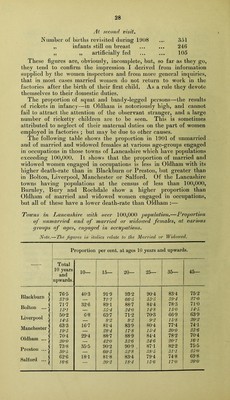
![hours in the mill and 12^ hours in sclioo], or 26 hours in the mill and 15 hours in school. I examined a lai’ge number of the “ half-timers ” in several of the largest schools and questioned the teachers as to them. So far as general impressions enable me to form an opinion, the signs of physical deterioration in these children, though apparent, and in the worst cases strongly marked, were not in the majority of the children so obvious as I had anticipated—it is possible that the system, if injurious, does not develop its full effects till later in life—the children appeared to enjoy the work in the mills, which in itself, apart from the hours worked, is not heavy, and few of them confessed that they felt it to involve hardship. On the other hand, the teachers whom I questioned all agreed in asserting that morally and intellectually and, most averred, physically, children so employed deteriorate rapidly. Morally, they lose the sense of discipline and exert a bad effect on the other scholars; intellectually, they fall behind in their work to an extent which one teacher appraised at 50 per cent., and ])hysically, most of the teachers maintained that the half-timers lost colour and vitality. The results of medical inspection of school children may be expected in course of time to throw useful light on this matter. The balance of impression and evidence points to the conclusion that children of 12 and 13 cannot be regularly employed in factories without ultimately suffering in health and vitality to a degree which can hardly fail to influence the death-rate. I was assured by mill owners that the requisite technical skill could readily be acquired in the factory at the age of 14. I visited two large cotton factories and a weaving shed, and carefully observed the girls at work. The employment is not arduous or exacting, and appears in most of its branches to allow intervals of rest and opportunities for sitting down from time to time. The girls are noticeably a stunted race as regards stature, but are for the most part plump and well-nourished. A leading practitioner in the town informed me that anaemia is prevalent among them, but I could not observe that it was more common than it is, for example, among domestic servants or shop girls. Anaemia and signs of fatigue, particularly as affecting the half-timers, were most obvious in those parts of the factory where the finer “ counts ” are spun, and where a higher temperature and a moist atmosphere are maintained, but, as Oldham produces chiefly low and medium “ counts,” this factor would not assume such prominence as it might in other towns. The tendency to anaemia is to some extent counteracted, not only by the fact that the mill girls can, as already mentioned, afford to buy good food and clothing, but also by the fact that most of them make excursions into the surrounding moorland country on Saturdays, Sundays and holidays, and nearly all take a week’s holiday at Blackpool or some sea-side resort every year. The proportion of boys and gills at dift'erent ages engaged in occupations is shown in the following table. It is seen to be less than in several of the other cotton-spinning towns. Thus Oldham with 25'1 per cent, of boys and 17'5 per cent, of girls under 14](https://iiif.wellcomecollection.org/image/b28143000_0030.jp2/full/800%2C/0/default.jpg)


 No text description is available for this image
 No text description is available for this image
 No text description is available for this image