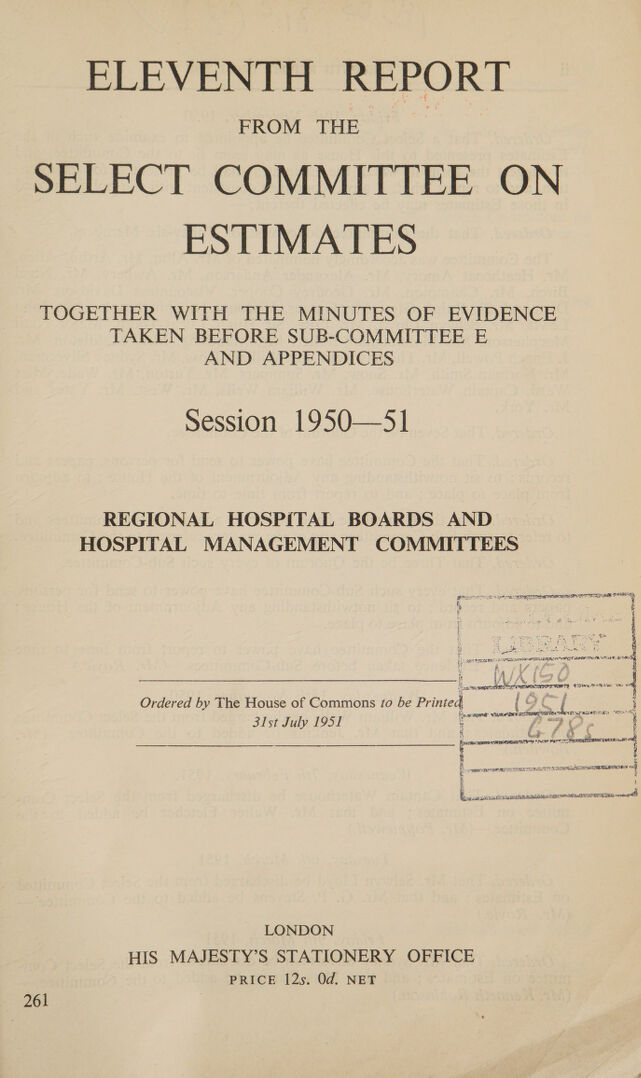
Eleventh report from the Select Committee on Estimates : together with the minutes of evidence taken before sub-committee E and appendices, session 1950-1951: regional hospital boards and hospital management committees.
- Great Britain. Parliament. House of Commons. Select Committee on Estimates
- Date:
- [1951]
Licence: Public Domain Mark
Credit: Eleventh report from the Select Committee on Estimates : together with the minutes of evidence taken before sub-committee E and appendices, session 1950-1951: regional hospital boards and hospital management committees. Source: Wellcome Collection.
70/348 page 30
![1 February, 1951.] [Continued. hospital management committees. Many months ago we asked the Minister if he would make the representation of consul- tants on regional boards and on hospital Management committees identical with that on boards of governors. He declined to do so at that time, but that is still the policy of the profession. _ 297. Is there a big difference in propor- tion?—A very big difference, yes. 298. Can you give us the figures?—As far as boards of governors are concerned, in the Schedule to the Act the Minister allows the senior staff employed by the board of governors to nominate up to one- fifth, and in practice I think he has always made it one-fifth of the governing body. In the case of regional boards, for exampie, a regional board will perhaps have not more than two, or perhaps even one, con- sultants under contract to that board sitting on it. Very rarely would it be more than two. Mr. Thomas Reid. 299. What is the total number of the board?—About twenty roughly, or a little over twenty. Chairman. 300. What do you suggest would be a better figure?—-We should say the same as that for the board of governors, up to one-fifth. 301. Up to four in number?—Up to four in number; that is to say doctors who are under contract with that board. Mr. Turton. 302. I notice in your memorandum under the heading of ‘“ Joint Consultation ” you say it would make for economy. Could you just explain that in greater detail to me?—yYes. Economies can only be made, without damaging the efficiency of a medical service, if they are made under the constant advice of those who are expert in the organisation. For that reason if any medical economies are to be made in a hospital, the staff of that hospital must be in full consultation with the governing body of that hospital. If amyone less expert than that staff were used as a source of advice to make economies, probably the economies that could be made would never be made and other economies which were damaging would in fact be made. 303. I can see the second part, but what I am wondering is this: is it suggested that if you had more joint consultation the medical profession could initiate in their suggestions economies which would be material in cutting down this very large expenditure?—I think so. Hospitals vary and are flexible, and they change in their work from month to month and year to year. Constant contact between the staff and the board of management would permit of suggestions being made from time to time by. the *stafl, wich suggestions would have a material effect in securing economies. Mr. Thomas Reid. 304. There is one thing I cannot quite » follow: you seem to rely on numbers to get this consultation, but there are doctors on the boards of management and on the regional boards. Presumably the doctors who are on thoroughly understand what is needed. Why do you want a greater number?—You have put your finger on the very heart of the question there. I would say this: the vital point in joint consultation between hospital boards and their medical staff is that the medical staff should be able to put a representative view and discuss a matter. Experience has shown us over many generations that that cannot be done just by one or two mem- bers. At our greatest teaching hospitals the medical committee or medical council for many years has in fact been composed of the whole senior staff. The medical council of St. Batholomew’s Hospital, for example, is over 50 in number. I! think it has some of the same virtues as a representative chamber which has over 600 members. It has the same virtue of representativeness. Chairman. 305. We are in danger of getting a little at cross purposes here. There are two questions. One is. whether there is adequate medical representation on _ the governing body itself to keep an eye on what is happening, and the other is whether there is adequate discussion between the governing body and _ the doctors to ensure that the development of policy is done with the full agreement of the doctors and on the best medical lines. I do not know whether we can altogether separate them, but as far as we can I want to deal first with representation on the boards and then come to the question of consultation in the more _ ordinarily accepted sense of the word. I think Mr. Reid put a question which you said was the nub of the matter, and I respectfully agree. Are there enough doctors on the boards and committees at the moment to keep an effective eye on what is going on and to say ‘“ No, you ought really to con- sult the medical profession before going into that’”?—-Our answer is emphatically that there are not enough. There are certainly not enough of the doctors who are actually employed in the hospital. Take, for example, one of the metropolitan regions containing perhaps about two](https://iiif.wellcomecollection.org/image/b32182478_0070.jp2/full/800%2C/0/default.jpg)