Eleventh report from the Select Committee on Estimates : together with the minutes of evidence taken before sub-committee E and appendices, session 1950-1951: regional hospital boards and hospital management committees.
- Great Britain. Parliament. House of Commons. Select Committee on Estimates
- Date:
- [1951]
Licence: Public Domain Mark
Credit: Eleventh report from the Select Committee on Estimates : together with the minutes of evidence taken before sub-committee E and appendices, session 1950-1951: regional hospital boards and hospital management committees. Source: Wellcome Collection.
97/348 page 57
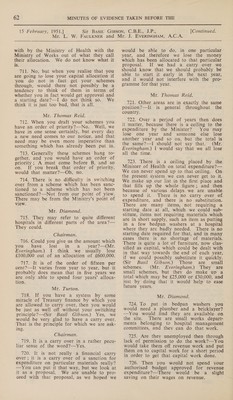
![8 si i 1951.] 643. It is not merely a licence to spend up to £10,000 without reference, but it is a licence to allocate £250,000 provided you allocate it as between small schemes?—Yes. What we want to do is to save a lot of this work. After all it is the Minister’s duty to provide these services; it is not our duty. Whatever we propose in the way of extensions, alterations or additions must be satisfactory to him. We quite agree we should satisfy him of the need, on the proposal itself, and upon its cost; but once having done that we say “ Leave us alone, and let us get on with it”. Mr. Thomas Reid. 644. Is it true to say that before the Minister makes his allocation he has before him all your proposed schemes?—I should say he has, yes. We have schemes costing up to millions of pounds. He has plenty of margin. Mr. Diamond. 645. As I understood the figures given by Mr. Everingham it was in fact £250,000 which it was being suggested should be spent purely within the discretion of the Board for that year?—(Mr. Everingham.) We send up detailed lists of our capital estimates, and they show the size of the job in two lists—one for those over £10,000 and one for those under £10,000. Those are our first estimates. Later on, if we ever want to alter that, because the work on any one scheme does not proceed as fast as we expected or we do not want to proceed with any scheme, we then have to go back to the Ministry for every scheme. If our return to the Ministry was limited to those schemes which were £10,000 and over, we would then be able to spend far more of our capital allocation in question because it would be more valuable as re- gards the last £250,000 which relates only to schemes under £10,000. Mr. Thomas Reid. 646. Would not the Minister lose con- trol if you were allowed to substitute one scheme for another?—(Sir Basil Gibson.) He would previously have approved the scheme. 647. He would not have approved the order of priority?—No. Mr. Diamond. 648. I do not quite follow this because, if he has approved, in round figures, £750,000 all-told, £500,000 in respect of certain schemes costing above £10,000 and £250,000 in respect of schemes costing be- low £10,000—is that right?—Yes. 649. Is then your suggestion that, if you are unable to spend the £250,000 on schemes costing £10,000 and below, you should spend it on schemes costing above £10,000?—No. 650. I understood Mr. Everingham’s point to be that thereby you would have more flexibility and therefore be able to spend up to your £750,000?—(Mr. Ever- ingham.) I was only suggesting that, if there are, say, one hundred schemes each in themselves costing under £10,000, we should be able to substitute other schemes also under £10,000 if for any reason the others do not proceed in time. 651. I apologise; I did not understand that?—That was the full import of it, that we should have a variation in regard to schemes under £10,000. 652. With regard to schemes under £10,000, if you are unable to proceed with a particular scheme under £10,000 which was approved, then you would like to have discretion to proceed with another scheme under £10,000 which has not been approved?—That is right. 653. Because it has not been within the total of £750,000 submitted?—-Yes. (Sir Basil Gibson.) When you say not approved, not approved for capital expenditure; we do not mean not approved as a scheme. Mr. J. Enoch Powell. 654. In. that case there would be no point in your submitting schemes costing £10,000 and under at all?—(Mr. Evering- ham.) Yes. 1 think in the first place we should do so to provide a break-down of the total sum between what we wish to spend on over £10,000 schemes and what would be left for the others. I think that should be done. At present approval of a variation takes so much time. It would only be a variation if we are at the end of the year and we have not been able to do anything at all. 655. Can you give an indication of the proportion of variations which you wouid expect to get? Obviously if you alter fifty per cent. of the schemes or if you alter five per cent., it makes a great difference to one’s outlook on the proposal? —(Sir Basil Gibson.) Let me put it this way. We get a capital allocation every year. It is our anxiety to spend that money if we can. Say we have a scheme at Lincoln, and then unexpected developments take place and we cannot go on with that scheme. The Lincoln scheme is estimated to cost £6,000. There is another press- ing scheme at Leicester. The proposal has been put before the Minister; he under- stands it; he has approved the need; he has approved everything connected with it, but it is not in that list. We want to bring it out of our cupboard, so to speak, and put it on that list and go on with it. If we could do it at once, we could probably spend the money. There is a delay in get- ting the Minister’s approval to the Leicester scheme taking the place of the Lincoln scheme, and by the time approval is](https://iiif.wellcomecollection.org/image/b32182478_0097.jp2/full/800%2C/0/default.jpg)