The constitution of pilocarpine / by Hooper Albert Dickinson Jowett.
- Jowett, H. A. D. (Hooper Albert Dickinson)
- Date:
- [1900-1905]
Licence: In copyright
Credit: The constitution of pilocarpine / by Hooper Albert Dickinson Jowett. Source: Wellcome Collection.
3/86 page 853
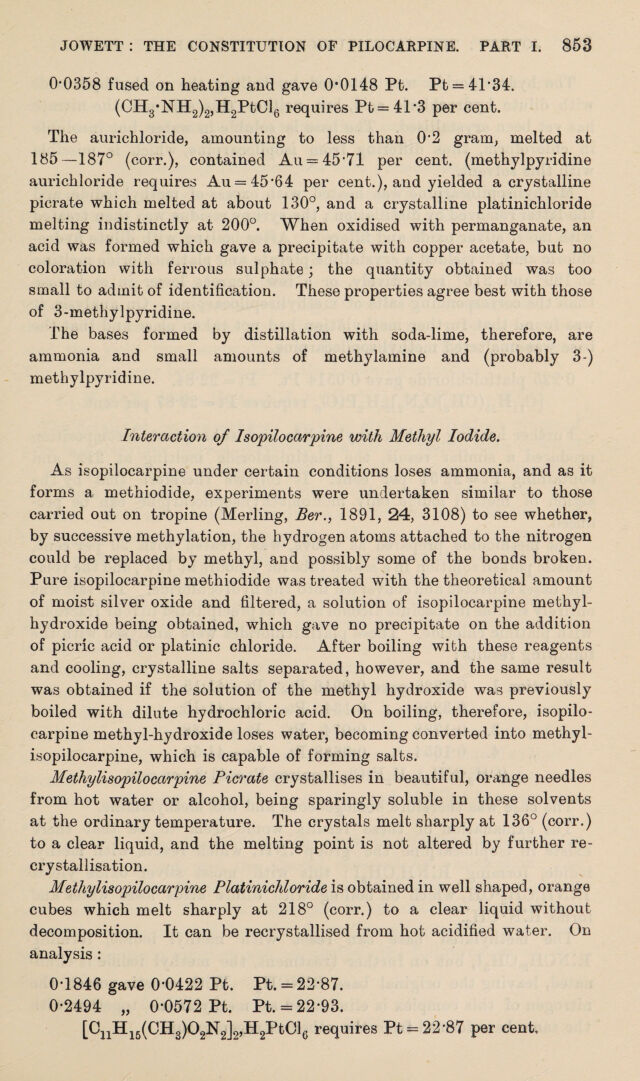
![0*0358 fused on heating and gave 0*0148 Pt. Pt = 41*34. (CH3*NH2)2,H2PtCl6 requires Pt = 41*3 per cent. The aurichloride, amounting to less than 0*2 gram, melted at 185—187° (corr.), contained Au = 45*71 per cent, (methylpyridine aurichloride requires Au = 45*64 per cent.), and yielded a crystalline picrate which melted at about 130°, and a crystalline platinichloride melting indistinctly at 200°. When oxidised with permanganate, an acid was formed which gave a precipitate with copper acetate, but no coloration with ferrous sulphate; the quantity obtained was too small to admit of identification. These properties agree best with those of 3-methylpyridine. The bases formed by distillation with soda-lime, therefore, are ammonia and small amounts of methylamine and (probably 3-) methylpyridine. Interaction of Isopilocarpine with Methyl Iodide. As isopilocarpine under certain conditions loses ammonia, and as it forms a methiodide, experiments were undertaken similar to those carried out on tropine (Merling, Ber., 1891, 24, 3108) to see whether, by successive methylation, the hydrogen atoms attached to the nitrogen could be replaced by methyl, and possibly some of the bonds broken. Pure isopilocarpine methiodide was treated with the theoretical amount of moist silver oxide and filtered, a solution of isopilocarpine methyl- hydroxide being obtained, which gave no precipitate on the addition of picric acid or platinic chloride. After boiling with these reagents and cooling, crystalline salts separated, however, and the same result was obtained if the solution of the methyl hydroxide was previously boiled with dilute hydrochloric acid. On boiling, therefore, isopilo¬ carpine methyl-hydroxide loses water, becoming converted into methyl- isopilocarpine, which is capable of forming salts. Methylisopilocarpine Picrate crystallises in beautiful, orange needles from hot water or alcohol, being sparingly soluble in these solvents at the ordinary temperature. The crystals melt sharply at 136° (corr.) to a clear liquid, and the melting point is not altered by further re¬ crystallisation. Methylisopilocarpine Platinichloride is obtained in well shaped, orange cubes which melt sharply at 218° (corr.) to a clear liquid without decomposition. It can be recrystallised from hot acidified water. On analysis : 0*1846 gave 0*0422 Pt. Pt. = 22*87. 0*2494 „ 0*0572 Pt. Pt. = 22*93. [CuH15(CH3)02N2]2,H2PtCl6 requires Pt = 22*87 per cent.](https://iiif.wellcomecollection.org/image/b30598667_0003.jp2/full/800%2C/0/default.jpg)