The museum report : a descriptive list of the donations for the years 1895-1902.
- Pharmaceutical Society of Great Britain
- Date:
- 1903
Licence: In copyright
Credit: The museum report : a descriptive list of the donations for the years 1895-1902. Source: Wellcome Collection.
Provider: This material has been provided by Royal College of Physicians, London. The original may be consulted at Royal College of Physicians, London.
49/80 (page 39)
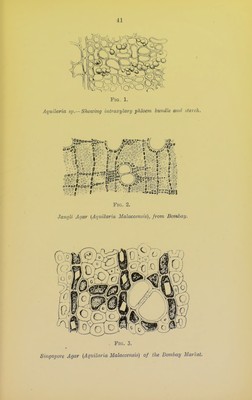
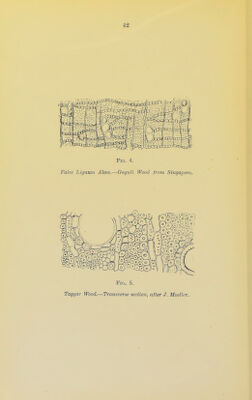
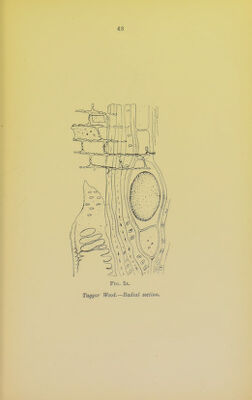
![Aloes Wood (/./// itinii Allies)/' This drug consists of heartwood in which a resinous deposit has been formed in hues or strias which vary in diameter and in distribution in different kinds of the wood. This resinous matter is absent from the young wood, and appears to be a patho- logical product (at all events in some cases) developed by injury caused by fungi or insects. It is especially developed in the isolated phloem bundles, hence the streaky appearance of the wood. The resinous matter is insoluble in water, alcohol or other, but is soluble in alkalies, and in chloral hydrate. The exact botanical sources of tlie different varieties of aloes wood in eastern commerce have long been doubtful. These woods are generally attributed to species of the genus Aquilaria, but some are evidently derived from other genera and families. The Museum is comparatively rich in these varieties, which include a series of specimens of the drug contributed some years since by Mr. J. G. Prebble, of Bombay. During the time that ■ Dr. -Tosef Moeller was investigating the microscopical structure of lignum aloes, specimens from this Museum were forwarded to him for examination. A report of the results he obtained was published in the Vhann. I'ost for 1896 and 1898, of which an abstract is here given so far as relates to specimens in the Museum of this Society, with a few illustrations of the different structures found in the more distinct kinds. Further information concerning aloes wood is given in Han- hitni Srienre I'djicrx, pp. 263-5; Jji/iiioc/,-, Mat. Med., ]\'est hulia, p. 239; Watt, Jh'rt.h'nni. PnuL, India,!.,^.lid; Linn. Soc. Trans., XXI., pp. 199, 206., XI., p. 230. Tkue Aloes Woods. The wood of the genus Atjiiilaria, from which the true aloes woods are derived, is characterised by intraxylary phloem strands, which have hitherto been found in no other wood (see Fig. 1) ; by the libriform tissue being replaced by fibre-like tracheids ; by the radially ai'ranged vascular groups sparingly surrounded Avith parenchyma; and by the medullary rays con- sisting of a single row of cells. The differences in the structure in the various species are not very pronounced. ('Iiinese Aijar, or Hiang-chai, from Hong Kong. The Museum specimens consist both of young wood without resinous deposit, and of pieces of resinous heartwood. This drug is referred by Dr. J. Moeller to Aquilaria iirandifiora, Benth. The phloem bundles often extend across more than one of the medullary rays, and occur also in the pith, which contains large prisms of calcium oxalate. The vessels are in short radial groups, and are not entirely encircled by parenchymatous cells, these being sparsely scattered. The medullary rays are free from crystals. Isolated parenchyma fibres are only to be distinguished by their pores. The tracheids are broad and slightly thickened. * Various local vernacular names are given to Aloes wood, e.g.. Agar, Garoo, Ood, Calambac, Eaglewood, etc.](https://iiif.wellcomecollection.org/image/b24757871_0049.jp2/full/800%2C/0/default.jpg)