The museum report : a descriptive list of the donations for the years 1895-1902.
- Pharmaceutical Society of Great Britain
- Date:
- 1903
Licence: In copyright
Credit: The museum report : a descriptive list of the donations for the years 1895-1902. Source: Wellcome Collection.
Provider: This material has been provided by Royal College of Physicians, London. The original may be consulted at Royal College of Physicians, London.
50/80 (page 40)
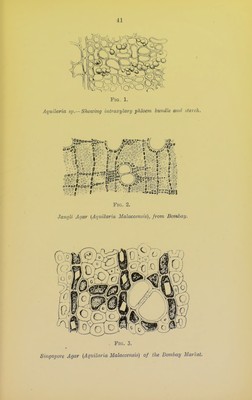
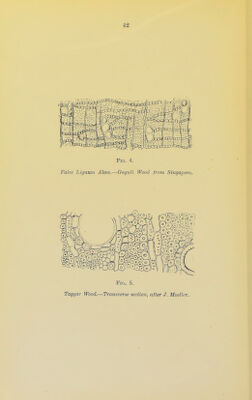
![Liiliiinii (tlnrs, of Bombiiy. This is the produce of Aijiiilaria A<iail<,<ha, Eoxb. It may be the kind which earned for the drug- the name of eaglewood, since the black resinous streaks recall the appearance of the markings on feathers. The vessels occur singly, or in groups of two or three, and parenchyma occurs irregularly outside the phloem strands. The medullary rays very rarely contain crystals, though the resinous matter occurs in them, and in the tracheal elements. (utiinli Aijar of the Bombay bazaars. This is said to come from Canton. In structure it resembles yhjiiilaria nidiulifinra, Benth., but the tracheids are broader and less thickened. The contents of the medullary rays and phloem parenchyma are of a more or less deep blackish-brown colour. Dr. Moeller doubtfully suggests Aiiiiilaria nji/iidsju'rina, Poir, as the source of this wood. .laiiiili Alia I- (Fig. 2), as well as the Singapore agar of the Bombay market (Fig. 8), is referred to Aijuilaria Malaccciisis by Dr. J. Moeiler. In the former the resinous lines are thicker (about 1 inch in diaiueter), and the transverse section shows them as a loose network of lines, \ to ]^ inch apart. In the Singapore agar (Fig. 3) the greater proportion of the wood is formed of dark bands with only narrow lines of pale Avood separating them. JaJio Jandjomi Pcuaiii/, from Borneo, is possibly the product of Aqiiilaria iiiicnirarjta, Baill., a Bornean species. Manrail/ii Ai/ar.—Mr. J. G. Prebble attributes this Avood to Aqiiilana Malancusis, Benth., and Dr. .J. Moeller confirms his opinion. The latter also refers a dark-coloured agar, from the India Museum, to the same species. In the former the dark resinous lines are very long and slender. In the marwadhi agar the wood is soft, the tracheids are not coloured, and the phloem strands scarcely browned with deposit. In the agar from the India Museum the wood is dark brown, as if impregnated tar, very hard, and aromatic when burned. The resinous matter is partly soluble in alkalies, and partly emulsified by them. The distinctive characters reside in the greater thickening of the elements, and the Avidening out here and there of the medullary rays into two rows of cells, and in the greater abundance of single crystals in the medullary rays and wood parenchyma. False Ai.oes Woods. (Tai/iili Ai/ar from SiiKjajioir, of the Bombay market (Fig. 4). This wood does not agree in structure either with Aijuilaria or with (jujiosti/his Mi(jiidi(tiuis, from which some of the false aloes woods are obtained. The vessels are irregularly distributed, frequently grouped radially, and are nut sitrnnntdcd irith jiaroi- r/ii/iiia, which is distributed in single, or rarely in double, transverse rows, which often anastomose, and thus give the wood a reticulated appearance. The libriform tissue consists of strongly thickened fibres. The medullary rays usually consist of a single row of cells, and contain numerous large crystals.](https://iiif.wellcomecollection.org/image/b24757871_0050.jp2/full/800%2C/0/default.jpg)