Licence: In copyright
Credit: Arterial hypertonus, sclerosis and blood-pressure. Source: Wellcome Collection.
Provider: This material has been provided by Royal College of Physicians, London. The original may be consulted at Royal College of Physicians, London.
206/234 (page 172)
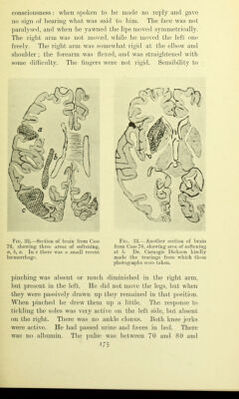
![X X x\n^ kjx Li x\rv x rjXViXL.o clinical manifestatious, might have heeu held to be cases of htemorrhage, did not the post-mortem examination confirm the contrary opinion. Two Fatal Cases Illustrating the Ordinary View. Case 7 3 was an old gentleman of 71 years whom I saw in consul tation. He had been seized on the morning of the day I saw him with right hemiplegia and aphasia. This occurred when he was slowly convalescing from what appeared to have been an attack of infiuenza with bronchopneumonia, so that his general condition was low and his circulation poor. The loss of power was not accompanied by loss of consciousness. The pulse when I saw him was soft and the blood-pressure low. There was no albumin in the urine. The patient became worse in a few days, and died comatose. The ordinary view of such a case would be that it began with a Inemorrhage, small in size, but sufficient while destroying some fibres to press upon adjoining ones; and that this initial haemorrhage was followed by a second and a larger one in a few days. There was no post-mortem examination, and so there was no oppor- tunity of checking the ordinary clinical opinion in this instance. The symptoms, however, closely resembled those in cases in which there was softening but no haunorrhage, as proved by post-mortem examination, and 1 hold that these cases guide us as to the nature of the lesion in such cases as this. Case 74 was a man aged 28, admitted to the lioyal Infirmary with left hemiplegia without loss of consciousness. He had been in the Infirmary some months previously, and was known to have advanced chronic kidney disease. His arteries were thick and hard. He was markedly uneniic, sometimes noisy and talkative, at other times seniicomatose or drowsy, hut lie recognised the Ward Sister, and could give the names of relations admitted to see him. In three days Ids temperature suddenly shot up to 105° to 106°, he became comatose, and died within twenty-four hours. ]\Iy hiter])reta- tion of the phenomena was tliat on admission the Ifiood su])ply to the motor strand on the rigid siile had been obstructed, and as his vessels were markedly constricted I leant to the](https://iiif.wellcomecollection.org/image/b28036591_0206.jp2/full/800%2C/0/default.jpg)