Licence: In copyright
Credit: Arterial hypertonus, sclerosis and blood-pressure. Source: Wellcome Collection.
Provider: This material has been provided by Royal College of Physicians, London. The original may be consulted at Royal College of Physicians, London.
210/234 (page 176)
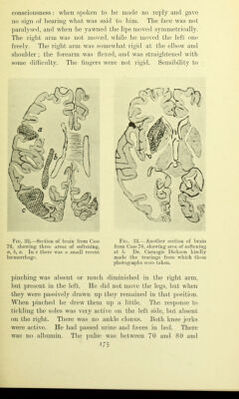
![slightly irregular, the vessel wall was thick, the htemomanometer registered from 180°—190°. He was put ou erythrol tetra- uitrate, aud ou the 20th iodide of jDotassium was also given. No marked change occurred in the symptoms; ou the 21st it was noted that he gave his left hand slowly when asked to shake hands. The patient died on the 27th of acute pleurisy, with some patches of broncho-pneumonia in the lobe affected with the pleurisy. The brain on the left side showed two considerable areas of subcortical softening, into one of which there was a small recent hiemorrhage; and a considerable area of softening into, and in the neighbourhood of, the lenti- cular nucleus. In this patient death was the result of a definite inter- current acute disease, so that the opportunity was afforded of checking the diagnosis of cerebral softening. Sections of the brain at two different levels are shown in the accompanying figures. The softened areas are shaded. In the posterior area marked c there was a recent hminorrhage about the size of a hazel nut. This had undoubtedly taken place into an area already softened, and tends to strengthen my opinion that fatal hseniorrhages may not infrequently be due to a primary softening, so that even post-mortem appear- ances may be quite misleading unless the possibility mentioned is fully recognised. GROUP V.—TWO SPECIAL CASES. Case 77.^—Temporary paresis aceompanyi'iig paroxysms of angina pectoris.—In this patient, Mrs. M., tet. 49, the leading feature was the recurrence at intervals of about four weeks of symptoms typical of angina pectoris, while the most striking phenomenon was the association of left hemiparesis with them. She had her first attack of angina pectoris seven years before I saw her. During that attack the left arm was paralysed, but it regained tlie greater part of the lost power in twenty-four hours; still, she asserts tliat it has never been as strong as the otlier one since then. The history given to me by her medical attendant. Dr. Blackstock of Eskbank, was that every few weeks slie suffered from angina pectoris; tliat when this su])ervened she became hemiplegic; and that 1/6](https://iiif.wellcomecollection.org/image/b28036591_0210.jp2/full/800%2C/0/default.jpg)