Licence: In copyright
Credit: Arterial hypertonus, sclerosis and blood-pressure. Source: Wellcome Collection.
Provider: This material has been provided by Royal College of Physicians, London. The original may be consulted at Royal College of Physicians, London.
44/234 page 22
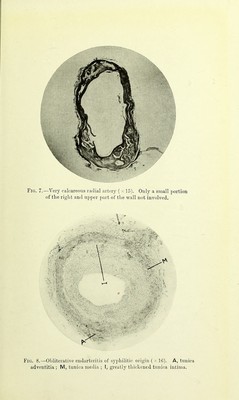
![and areas of small-celled infiltration in all three coats. This condition, which anatomically entirely corresponds with the obliterative endarteritis of the smaller syphilitic arteries, I have always regarded as of syphilitic origin. The condition, as it occi;rs in the cerebral arteries, is represented in Fig. 8. CALCAREOUS INFILTRATION OF THE TUNICA MEDIA. Clinically, calcareous infiltration of the tunica media is indistinguishable from calcareous infiltration of the thickened intima in atheroma. In fact, in advanced calcareous infiltra- tion, it is by no means always easy to determine how much of it is intimal and how nuich medial. This is owing to the fact that when it is intimal there is so little of the media left that the doubt arises whether it is not the media itself which is infiltrated. The position of the elastic lamina often effectively helps in this determination. The change is one which does not require fuller consideration here. In Figs. 5, 6, and 7, the media is more or less involved in the calcareous infiltration. ARTERIO-SCLEROSIS. In 1901, in a paper read before the Edinburgh Medico- Chirurgical Society, I submitted the results of the examination of the radial ^ud other arteries, taken from sixteen cases which had been under my care, and in which tliere had been markedv thickening of the radial arteries during life. Since that time I have examined many additional cases, but they have only confirmed my previous observations, that the changes \vero totally different from those in atheroma, and strengthened the opinion I then expressed, that as the term arterio-sclerosis was in common iise it ought to l)e retained, but its a])plication confined to the changes which I then showed to l)e present. The changes may be defined I'oughly, as great thickening of the wall of tlie artery, with diminution in the size of its lumen. The changes which led to the thickening, when examined in detail, were seen to consist of—(1) a marked thickening of](https://iiif.wellcomecollection.org/image/b28036591_0044.jp2/full/800%2C/0/default.jpg)