The diseases of the stomach : with an introduction on its anatomy and physiology, being lectures delivered at St. Thomas's Hospital / by William Brinton.
- William Brinton
- Date:
- 1859
Licence: Public Domain Mark
Credit: The diseases of the stomach : with an introduction on its anatomy and physiology, being lectures delivered at St. Thomas's Hospital / by William Brinton. Source: Wellcome Collection.
Provider: This material has been provided by the Francis A. Countway Library of Medicine, through the Medical Heritage Library. The original may be consulted at the Francis A. Countway Library of Medicine, Harvard Medical School.
19/426 page 3
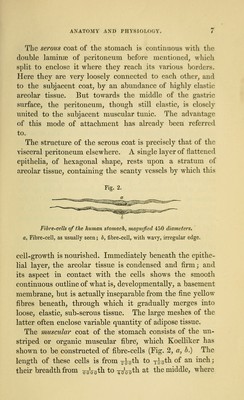
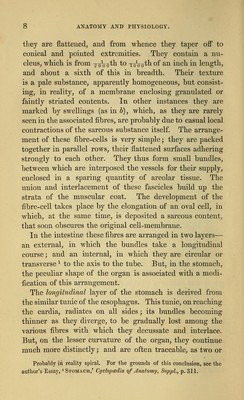
![away to the pyloris (b, b), where a sudden constriction marks the site of the valve. The dimensions of the organ arc even more variable than its form. In the healthy middle-aged male, the moderately distended stomach is about thirteen to fifteen inches long; and its diameter, at the widest part five, near the pylorus two, inches. Its total surface is >ut one and a quarter square feet; its capacity about \ 7 5 cubic inches, or five pints; its weight seven ounces. The attachment of the stomach is effected chief]v by the continuity of its extremities with the more fixed duodenum and oesophagus. The former tube is connected with the posterior wall of the belly ; the latter perforates the diaphragm, so as to enter the abdomen about one inch in front of the left border of the aorta, by an aper- ture which is everywhere muscular, though close to the posterior border of the tendon. The fixation of the stomach is also aided by certain processes of peritoneum. To the left of the oesophagus, the short phreno-gastric omentum passes from the diaphragm to the cardiac pouch, which it reaches somewhat posteriorly. Still lower down, the stomach is united to the spleen by the g astro-splenic omentum. The lower border of the organ gives off the great omentum; this descends for some distance towards the bottom of the belly, and is then reflected upwards to the anterior border of the transverse colon, which it splits to enclose. The upper border of the stomach is attached by means of the g astro-hepatic or small omentum, which descends from the transverse fissure of the liver. All of these folds are double; though the four layers of the 1 For women and children, these estimates require a proportionate reduc- tion. They are increased by habitual distension, and by the relaxation of uld age; diminished by habitual exercise, or by the practice of taking very small meals (as in dilative emphysema of the lungs).](https://iiif.wellcomecollection.org/image/b21043589_0019.jp2/full/800%2C/0/default.jpg)